TaalSutra, Creation: From Dashavatar to Elton John
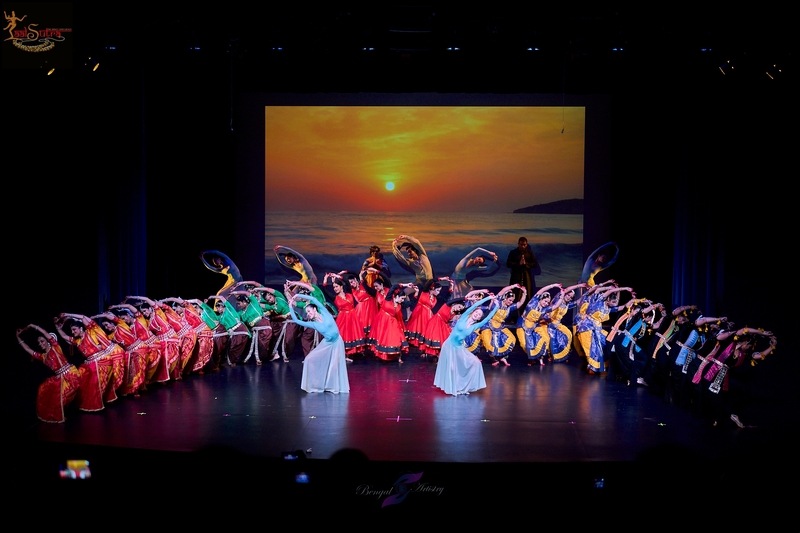
Finale – Ensemble Creation
A full-stage ensemble gathers beneath a warm sunset projection, forming symmetrical lines that evoke collective harmony. The visual synthesis of color, formation, and scale signals restoration, concluding the work’s journey from cosmic origin to contemporary responsibility.
TaalSutra, Creation: From Dashavatar to Elton John
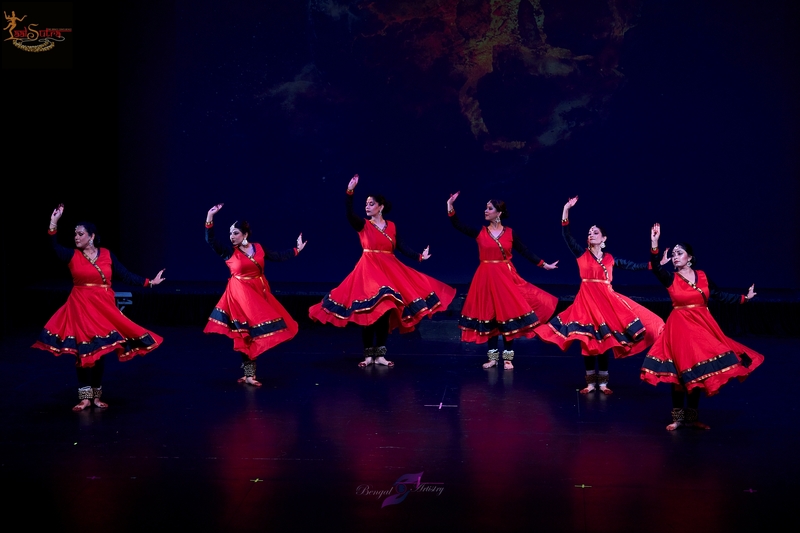
Kathak Ensemble Segment
Swirling red costumes amplify synchronized chakkars, creating centrifugal motion across the stage. The visual velocity of spinning skirts reinforces Kathak’s percussive precision and theatrical dynamism within the production’s evolving narrative arc.
TaalSutra, Creation: From Dashavatar to Elton John
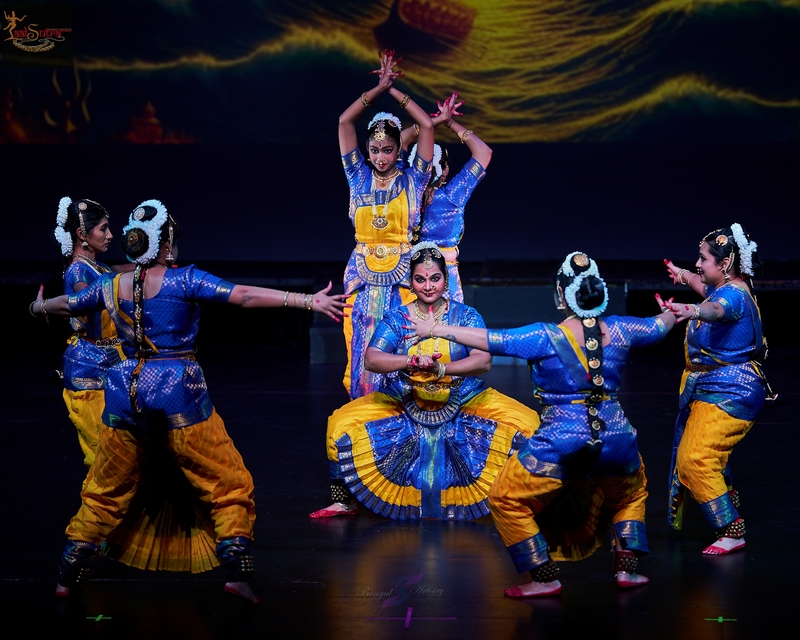
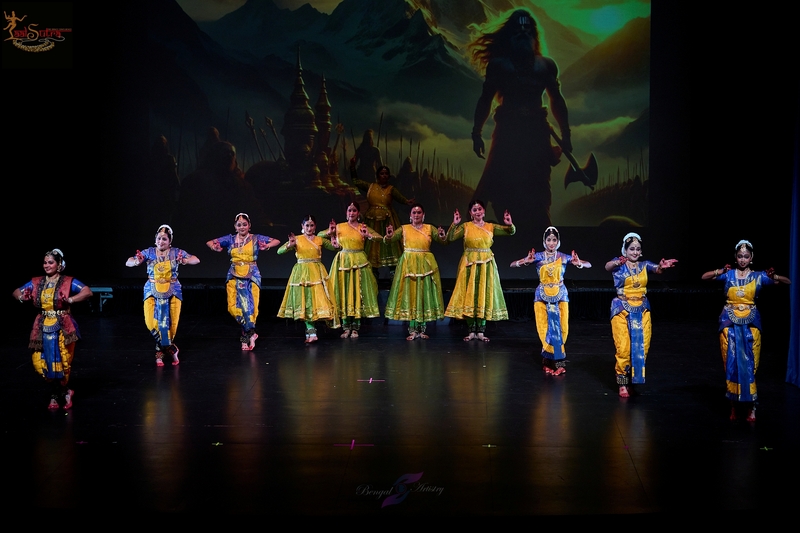
Kurma Avatar – Bharatanatyam
A central sculptural pose anchors the ensemble in symmetrical formation. Grounded stances and sharply defined geometry reflect Bharatanatyam’s architectural vocabulary, reinforcing Kurma’s role as the stabilizing tortoise who supports cosmic balance.
TaalSutra, Creation: From Dashavatar to Elton John
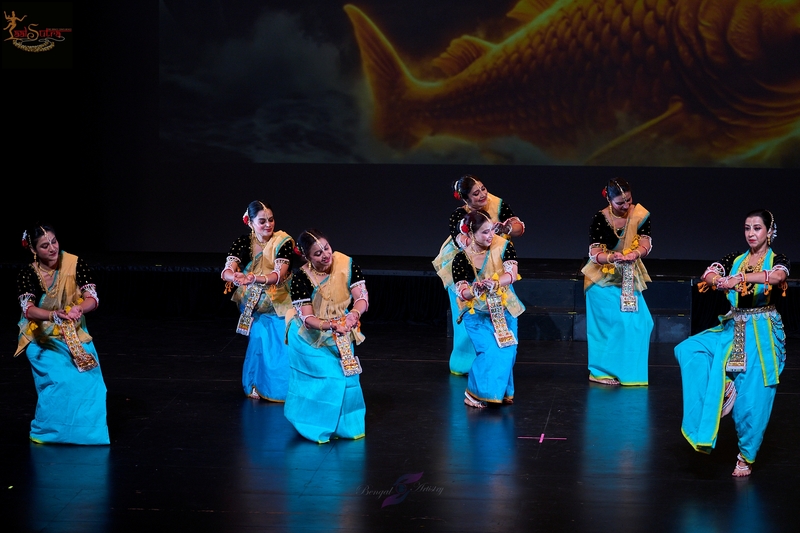
Matsya Avatar – Manipuri
Dancers in flowing blue costumes move in circular formations, their arm arcs evoking water’s rhythm and continuity. Manipuri’s fluid movements underscores Matsya, the fish incarnation of Vishnu, aligning mythic preservation with the visual language of currents, origin, and renewal.
TaalSutra, Creation: From Dashavatar to Elton John
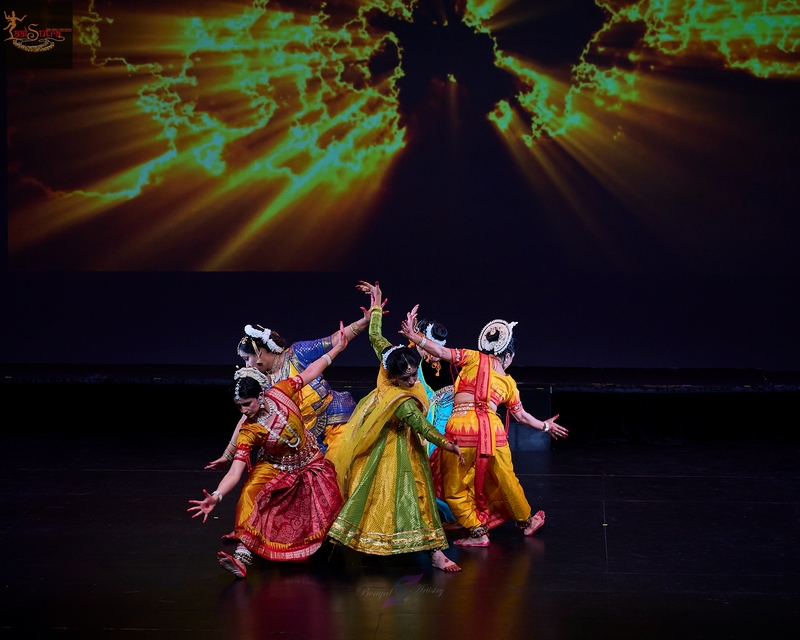
Parashuram – Kathak
Against a darker stage palette, strong stances and dynamic spacing convey tension and force. Kathak’s rhythmic intensity and dramatic carriage embody the warrior energy of Parashuram, heightening the narrative’s shift toward confrontation and upheaval.
TaalSutra, Creation: From Dashavatar to Elton John
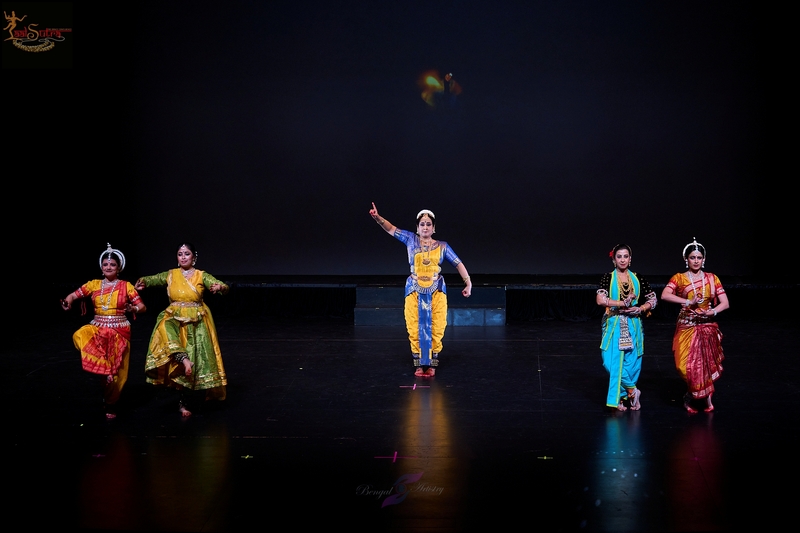
Yada Yada – The Four Classical Forms
Under radiant projection, dancers representing multiple classical traditions share the stage in layered formation. Referencing the Bhagavad Gita’s promise of divine return, the segment emphasizes unity across stylistic diversity within South Asian performance traditions.
TaalSutra, Creation: From Dashavatar to Elton John
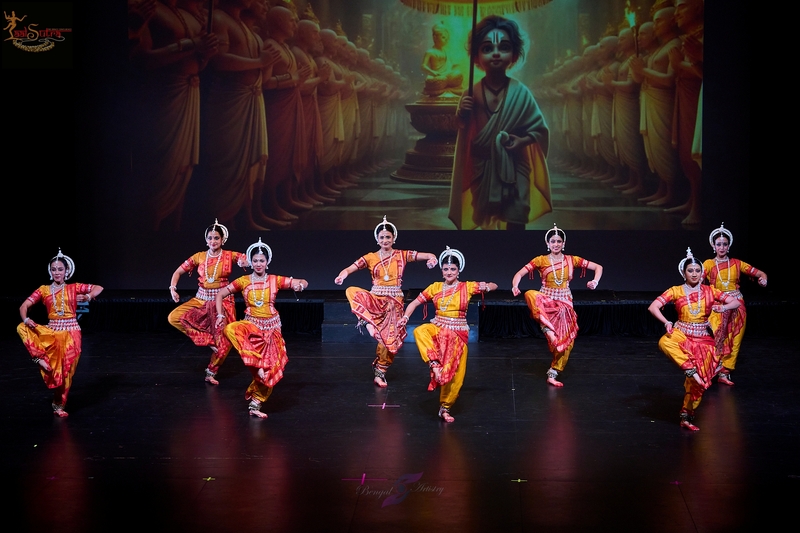
Vamana Avatar – Odissi
Framed by temple-inspired projections, dancers hold tribhangi silhouettes that emphasize curved lines and poised restraint. Odissi’s sculptural lyricism mirrors Vamana’s transformation from modest figure to expansive cosmic presence.
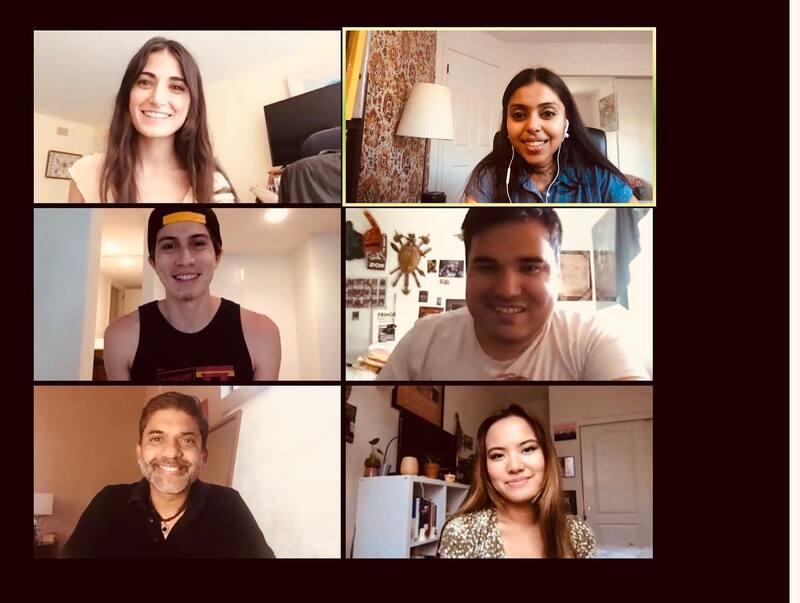
A Zoom rehearsal with the cast of Dealing Dreams, a play by Jeffrey Lo. The play, which is based in the Bay Area, is about chasing big aspirations while confronting the emotional costs and realities that come with them.
Deepa Fernandes is a bilingual, award-winning radio and print journalist born in Mumbai to Manglorean parents and raised in Australia. She began in Sydney community radio at 2SER, later reporting across Latin America and the U.S., with a focus on immigration, education, and communities often left out of mainstream coverage. She served as a co-host of NPR and WBUR’s Here & Now, reported as an immigration correspondent for the San Francisco Chronicle, and founded People’s Production House to help diversify journalism. A three-time LA Press Club “Radio Journalist of the Year,” she has also received an LA Area Emmy.
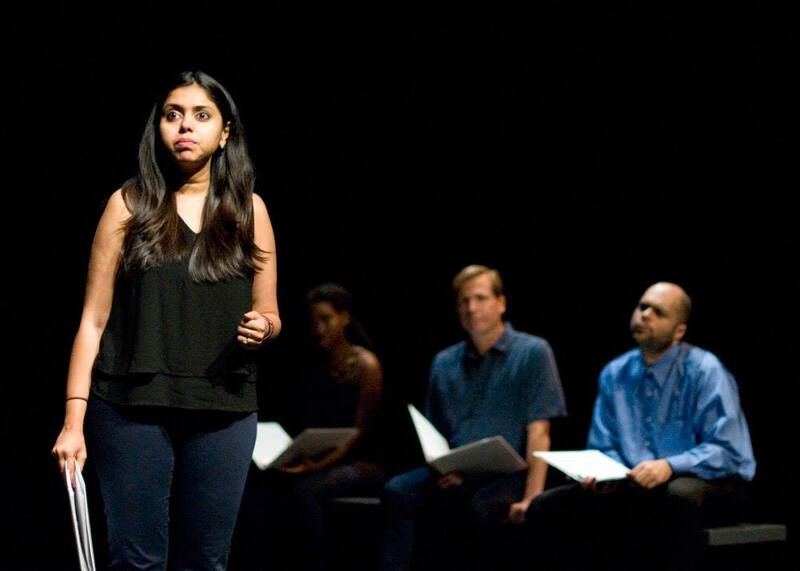
A scene from the staged reading of Democratically Speaking. The play examines the evolving ideals and lived realities of democracy, tracing its roots from ancient Greece to movements like Occupy, through a vibrant staged reading that weaves together voices from across history—from classical thinkers and playwrights to modern activists and political leaders—creating a rich, multi-perspective dialogue on power, justice, and civic life.
Desi 1170 AM began broadcasting South Asian talk programming under Universal Media Access, marking the start of a new radio era serving the Bay Area’s South Asian community.
Desi Theatre is a Silicon Valley–based community theater group founded in 2023 that focuses on Hindi-language comedy for diasporic audiences. Its productions include adaptations of South Asian plays and films as well as original works, often presented with English supertitles to engage multilingual audiences. Serving both South Asian and broader Bay Area communities, Desi Theatre contributes to the region’s expanding landscape of accessible, community-driven performance.
Promotional poster for Caught in the Net, a Hinglish adaptation of Ray Cooney’s farcical comedy. The play follows a London taxi driver who secretly maintains two separate families, until a web of misunderstandings and mistaken identities begins to unravel his carefully constructed double life. Known for its rapid pacing and escalating comic tension, the production reflects Desi Theatre’s focus on Hindi-language comedy adapted for diasporic audiences. By incorporating bilingual dialogue and cultural references, the staging situates a classic British farce within the linguistic and social realities of South Asian life in Silicon Valley.
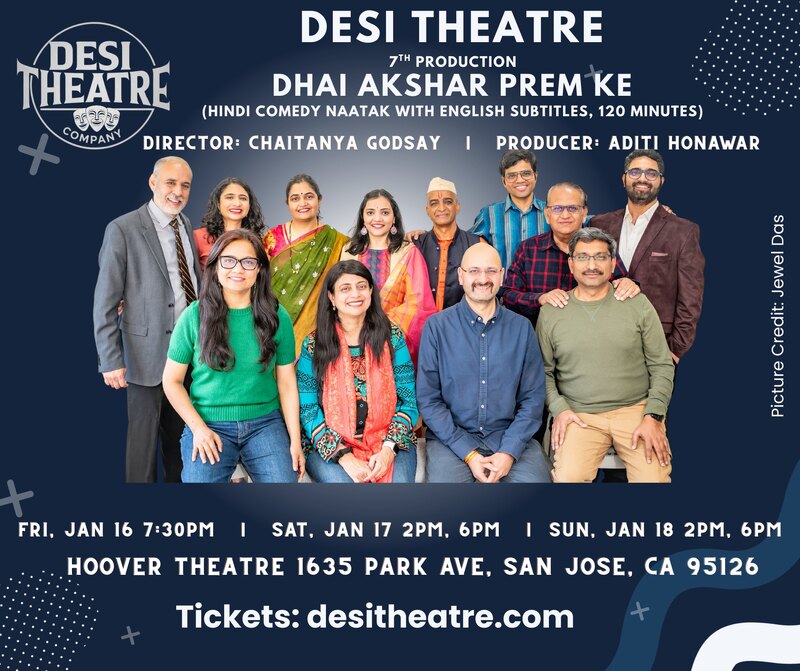
Promotional poster for Dhai Akshar Prem Ke, a Hindi-language comedy adapted from a well-known Marathi play by director Chaitanya Godsay. Presented in January 2026, the production centers on a middle-class family navigating love, generational expectations, and emotional transition. The narrative follows a daughter who abruptly announces her intention to marry a businessman she has fallen in love with, prompting tension and negotiation within the household. In parallel, the son’s unsuccessful romantic pursuits introduce a contrasting trajectory, reinforcing the play’s exploration of differing emotional outcomes within the same family. As the family comes to accept the daughter’s decision, the father’s sense of loss underscores the shifting dynamics of parent-child relationships. Blending humor with moments of emotional reflection, the production exemplifies Desi Theatre’s approach to Hindi-language comedy that engages with everyday family life. The use of English supertitles further situates the performance within Silicon Valley’s multilingual and cross-cultural audience environment.