To you, this day my votive verse I frame,
Who wear with worth the Teacher's noble name, —
Lamp of the mind to simple and to sage,
Youth's curious eye and tongue of ripened age,
The poor man's banker and the rich man's friend,
And strength of arms that conquer and defend.
Your glorious mission, measure it who can!
It fills the broad circumference of man,
Invades the glooms where eldest shadows brood,
And sweeps the dizzy verge of Angelhood;.
Allures the baby with a fitting gift
And feeds the greybeard from your boundless thrift;
To every age pronouncing Wisdom's plea,
It brings an echo from eternity!
Armed with the weapons time and toil have wrought,
Annealed in centuries of consuming thought,
The slow results of daring search and guess,
Didactic failure and divine success, —
The Teacher leaves the world's gray dawn behind,
And boldly sounds the forward march of mind.
Not now to dwell in ruins of the old,
He rakes their ashes and disturbs their mould,
Reads arrowy signs from Nimrod's temple aisle,
Unwraps the long-tanned mummies of the Nile,
Tracks through Pompeii's palace and street
The car's stone groove and tread of sandalled feet;
For better homes the bright green present yields,
Made sweet with incense of our clover fields;
And nobler temples and diviner shrines
Gleam where our sun on spire and bell-tower shines.
But from the Past he wrings reluctant lore,
To light the paths that open far before;
Beacons the rocks with phosphorescent fire,
From bones of crumbled empires, from the mire
Of rank Campagnas feeds the glowing throat
Of engines almost wise enough to vote;
And like the Vestal Nature when she burns
In tulip flames and lily's fragrant urns,
The grey dead things of winter, his clear brain
Consumes old husks to cherish the new grain.
"Stand and deliver" is the hail he gives
To all that was or is, that lived or lives;
Nubia and Luxor, from their giant mass,
May yield one atom for his chemic glass,
One vital fact from all their dusty lees—
The mummy wheat of thirty centuries, —
That in his garden into new life fed,
May grow to feed the hungry soul with bread.
Old Greece will give him, what all time will guard,
The tragic muse and Scio's sightless Bard;
Rome lend a sparkle of heroic fire,
With silvery music of her Mantuan lyre.
All the dead nations from their funeral urn
Shall teach the lesson that they would not learn,
That men are brothers, and they build to fall
In hopeless ruin who build not for all;
That life is progress, and her true souls march
Abreast with Time through his triumphal arch,
And realms that falsely move, or idly wait,
Are ground to powder by an iron fate.
With pick and hammer, and an eye that knows
Life's lightest foot-print in the rock, he goes
Into a past that makes the long array
Of buried realms the infants of to-day,
Among gigantic bones in ruin hurled,
The wallowing monsters of a seething world,
Primeval pines and plumes of palmy fern,—
The old flames fixed that loosened still will burn;
The long procession of ascending lives
From starry forms that multiply their fives,
Through jointed rings, through shells aglow with hints
Of life's great sunrise in their roseate tints,
To the last form, predicted from the first,
That stands erect, the flower of soul full burst,—
Finding the same great lesson, God in all,
And life for ever onward! To his call
The recluse Darkness renders up her keys,
And tongueless Death his rock-bound mysteries.
Then when the past, condensed in one quick word,
Has lent what fire its bounding pulses stirred,
He waves it back into its silent grave,
Rich with the worth or warning which it gave,
And makes the living Present the free heir
Of all his wealth, uncumbered with its care.
From theme to theme, as his high march proceeds,
Into what realms his noble calling leads;
No field too poor to give some hidden charm,
And none too far for his extended arm.
A vital meaning, unexhausted yet,
Lives in the symbols of his alphabet,
The very syllables conceal old thought
Like ancient fossils to new figures wrought.
Words are historic, and a lingering noun
Tells where a nation, or a god went down;
A root strikes backward to remotest years,
And infant Cain's first "Papa" greets our ears
From the last " Ba-by." In our parts of speech
Souls of old masters, clinging, breathe and teach,
And nature, faithful as to grass and tree,
Feeds all our tongues to live and grow as we.
What others know not, and who scarcely yearn
To know, the patient teacher toils to learn,
Most diligent of his pupils, in whose mind
Must lie, well marked and numbered where to find,
All shreds of knowledge, all odd ends of lore.
More vast and various than the village store;
Where whoso calls for whatsoever fact,
It comes down straightway from its shelf unpacked ;—
How bees make honey, and where rain is born;
Who killed Tecumseh; who invented corn;
Why clouds and wind prevent the falling dew;
What greens the grass, what makes the clear sky blue;
When earth turns over what forbids to drop
The tongs and poker from his chimney-top;
Why red is red, and by what swift machine
Its sanguine wavelets could be split to green;
What the sun weighs, and why the old cat’s hair
Flashes and crackles in the wint’ry air!
Wherefore in adding carry one for ten,
And whence came first the thought of Soul to men.
When with his solvents, and the alembic’s glow,
The teacher racks all elements below—
Like some dark wizard in the moon’s eclipse,
To wring their secret from the panting lips
Fading to dissolution, what a smile
Of triumph flits across his own the while;
For he has touched the chord of kindred there,
Which binds wood, wave, and rock, and the impalpable air!
And with how grand a flight he leaps the bar
Of earth, and soars to planet, sun, and star;
Measuring their girth and sounding the great deep
With his sure plummet, far as light can sweep.
Now with his slender prism, a crystal key
Turned in the wards of far Immensity
Whose doors fly open at his touch, he tells
What lava floods Cor-Hydrae’s fiery wells,
And what tried metal, flashing through the sky,
Forms the red sword on vast Orion’s thigh!
Not wildest fancy could such records ope
As he reads coolly from his Spectroscope;
Or now that wizard glass that lefts the pall
From teeming atoms and the world of small,
Reveals the boundless sympathies that run
From the least monad to the farthest sun.
How great, how noble is the Teacher’s task,
Lavish of all that eager minds can ask,
And prompt to kindle longings where the spark
Of first young wonder slumbers in the dark.
Like an Archangel awful Duty stands
To guide the motion of his guiding hands,
For all the future takes a fateful cast
From this potential; heir of all the past!
Young souls around me, eager, fair and strong,
Joint heirs with him I glorify in song,—
Minerva’s priest for this hour, standing here,
I speed you onward to your great career,
Touching your foreheads with the anointing oil
For that grand fellowship of glorious toil!
In all the petty cares that throng the way,
The thousand crosses and the crown’s delay,
Walk nobly, calmly, with a courage nurs’d
On that long patience that can tire the worst,
Nor ever lose, though all the world forget,
The sense of your high calling, and the debt
Ye owe the future; while on either hand
Duty and Honor, guardian Angels stand,
Let wisdom teach, Love rule, and Fancy cheer
The flocks ye lead by waters cool and clear!
O, country teachers, on your mission bound,
Grimly content to labor and board round,
To warm the spare beds gathering damps and fleas
Since last year’s “school marm” packed her thin valise!
My mind, clairvoyant, follows as you go
To each warm vale, or hill of whieling snow,
Where the white school-house, with its bell-call clear,
Stirs like a harp the tingling atmospohere,
And the fair benches in a rising line
Invite the pupil to aspire and shine.
While some I see invade the sunny South,
With inkhorn mightier than the cannon’s mouth,
Solving the riddle of our wise and great,
By Greene and Greenleaf, syntax and the slate;
Laying for reconstruction’s bottom bricks
Your Spellers, Readers, and Arithmetics;
Others, half-lost in woods, or perched on high
To catch the favors of our Eastern sky,
Teeth chattering, hold their rural empire firm,
Freezing and broiling through a winter’s term,
Where some gray hovel crowns a gusty bank,
By hungry jack-knives gnawed in every plank,
Where little boys, with vainly dangling feet,
Cling to the hard pine by their trowsers’ seat!
Great shambling lads hawed in and gee’d away
Scrape iron-shod the floors where north winds play,
And blameless girls, close-cramp‘d in penance-racks,
Drive shoulder-blades through faded Merrimacks!
But here and there, unconscious of their fate
Sit all the guardians of the coming State;
Some little Johnson, “swinging round” even now,
Here spoils the breeches he should learn to sew;
Some sober Seward, on vague fancies bound,
Wants all the north-pole for his coasting-ground;
There in the snow-breach the young Ellsworths pant,
Here grimly tugs in smoke a sturdy Grant;
And yonder, grappling with some root obscure,
The new Ben Butler digs in miniature!
That little girl whose sweet and timid face
Blooms at your glance, shy nymph of ever grace,
I hear her called high priestess of high Art,
Keeping all white her pure and simple heart;
While this, with spicy wits and zeal elate,
Shall sit in Congress for the Nutmeg State!
That moon-faced lad whose eye forever smiles
Whose freckles map the Polynesian isles,
Under that shocking shock of sandy hair
Hides what will make the Twentieth Century stare,
A Sky-Propeller and Heaven-Navigator,—
Through in six hours, from here to the Equator;
This morning leaving at a moderate jog,
To-morrow flashing through a London fog;
Before the sun twice shifts the earth’s black robe
He’ll whistle Yankee-Doodle round the globe!
There sits a lad, a little prone to laugh,
Whose head contains the Planet Telegraph,
With “News from Neptune” by “The Morning Wink;”
And “Last Advices from Creation’s Brink!”
Little suspecting any thing so odd,
As slily now he shies a paper-wad
Full on the nsot of yonder wiry chap,
The future President of ————all the map!
As lambs at sucking, work their inner pump,
By its long handle, (sheep have but the stump,)
With vigorous waggle, and with many a bump,
So yonder boy, topped out with shades of red,
Waggles his knees and bobs his russet head
To draw out knowledge, from its fount that runs
A little dry for Wisdom’s younger sons.
Here one whose mental habit is to see,
Buzzy for “busy,” thinking of the “bee,”
Proclaims his work by one incessant hum,
That makes you wish him idler, or more dumb;
But this you’ll notice, when and where he goes,
He’ll let the gaping world know all he knows!
There, “Lazy Lawrence,” spite of bulk and strength,
Along the bench lops, slouching at full length,
Waiting till learning ventures within shot!
As if such shy game balked a chase too hot.
He'll keep a tavern or " saloon" half-sunk ;
Smoke, yawn and gossip, and die rich—or drunk!
But sturdy Jack, mouth open, arms a-crook,
On clutching fingers leaning, seems to look
Straight down the hole where learning skulks, no doubt,
Eager and resolute to dig her out!
He may be poor through all this earthly strife,
Yet shall the world grow richer for his life.
Yonder, I see, with lip fallen idly down,
His only study of the sort called " brown,"
The youth predestined to give looks the lie
In paths undreamed in our philosophy.
His mind is absent, like the busy dame
Whose " Not at Home," means " quite so—be the same!"
Down from the parlor to some dusky bin,
His soul has gone, and drawn the latch-string in ;
When it comes back, some sudden light, inwrought,
Will show what fine intoxicating thought
He drew from that dim cloister of his skull,
Where the mind busy, left the face so dull;
It may be some grand Poem, clothed in verse,
Or deeds that make their glory who rehearse;
Or, he may speak, almost beyond his will,
Words that create wide realms of good or ill;
Good as the thought is noble, ye inspire,
Ill, as it takes from you unhallowed fire.
Called into line like soldiers on parade
In one full class is every mood displayed.
Here, bolt upright the Miss who will not miss
Stands like a statue of Semiramis;
And there a long-sparred craft, not balanced well,
Rocks fore and aft as in a heavy swell;
Good sooth, he has just weathered a frightful spell;
Behind him one with gravity like a goose,
All on one leg,—the other lying loose,—
On the left instep twirls the dexter toe,
Boring for wit it might be, by the show.
Another leans upon a bench, and tries
To piece his brain's defection by his eyes,
Catching the catch-word from an open book:
If he find fame 'twill be by hook or crook!
There in a row-two girls upon one stalk,
Like a pink border in a garden-walk,
The benches bloom with lasses who make bloom.
The sober brownness of the little room.
And you who tread that platform's narrow neck
Like a bluff skipper on his quarter deck,
You, the grave teacher, do you quite discern
How more than all you teach is there to learn?
What tremors of quick nerves you need to soothe,
To win harmonious numbers clear and smooth ?
How that instinctive brain its thought lets fly
Like a swift falcon quarrying in the sky;
And this grave matron in a pinafore,
Leads Fact and fancy through the same straight door?
How one crampt heart wants love, as flowers the sun,
To teach its vagrant tendrils where to run,
One heavy brain with sluggish blood replete,
Wants patient care to guide its tortoise feet ;
And one, too lavish of its vital stir,
Needs the firm check where others need the spur.
Wise must you be in more than books contain
To catch the key-note of each varied brain,
And hold these wits in harness lax or stiff,
As plods the hack or soars the hyppogriff.
"Pleasant the task to rear the tender mind!”
The soul possessed in patience so may find!
"To teach the young idea how to shoot,"
Though his first shots may strike too near, to suit;
In that old regime well nigh dead and gone,
"Just as the twig was bent,"-they laid it on!
Supposing knowledge, needing larger doors,
Would come the readier through the loosened pores,
To give our jaws more vigor for their job,
They brought their mental "feed" upon the cob,
And when some heads refused the precious grist,
As if too full for more, by dint of fist
They knocked its ears to shake the measure down,
And quenched incipient brightness with a frown.
My memory wanders to the old brick pile,
Where austere Science never deigned to smile,
Where through the frozen moons the sturdy swain,
Who ruled stout oxen on the summer plain,
Unskilled to peddle, uninspired to preach,
Swung the vindictive birch and claimed to teach!
There rank by rank the verbal victor took
His conquering march through Webster's Spelling Book,
From a-b ab, to where in awful length,
"Om-pom-pa-noo-suck" tried his growing strength!
With what a pride he made his bold advance
On all the dead, unburied consonants
Of "phthisic," "bdellium," and the long array
Of words spelled right in just the wrongest way;
While feebler souls with heads and tongues too thick,
Stumbled o'er mutes, and let the long I's stick
Like herring-bones, close packed in hopeless jam,
In jaws tripped up on "parallelogram!"
Murray and maple, grave Daboll and birch!
With charms whose difference baffled our poor search,
Alike their grim asperities displayed,
While knowledge fled as flies a timid maid,
When wits were staggered by the Rule of Three,
The "maple rule" cleared up the mystery:
If passive verbs hung fire in some dull brain,
Birch said “to suffer," by the sense of pain.
I see once more, and shudder as I look,
The fearful records of my copy-book,
Where hieroglyphs ran, crazed with dread or drink,
Like tracks of rescued spiders drowned in ink;
And " Mend you may," drawn black in frightful signs,
Where hopeless mockery could you read the lines!
For "Masters " better skilled to swing a goad
Than a grey goose-quill, kept the old farm-road,
Steered pens like oxen, with a well-worn switch,
And scored all errors where they first could reach.
But they are gone and other days are come,
One short step nearer earth's millenium,
An age that honors brain, and growing bold
Shall esteem wisdom rather than fine gold;
While Knowledge soars with broadening wing sublime,
Where the brute hoofs of Power could never climb.
‘Tis yours to lead the new age on its course
By warm allurements, not by chilling force,
To be the vanguard of that better day
When man shall yield to love's diviner sway;
Yours to unfold by warmth and light, the young,
And charge with meaning every prattling tongue;
To teach the eye in simple things to find
The first tuitions of the growing mind;
Some quickened sense of seeing to impart
From all fair forms of Nature and of Art.
And slowly up, by sweet attractions brought,
Guide the clear-drawn perception into thought.
Ye build for all the future, each alone
On some low wall or column of his own,
Yet so shall build, if worthily are laid
The firm foundations of your fair arcade,
That all the tower, from base to coping stone,
Shall rise harmonious, moulded into one!
Learn independence, and divine self-rule,
And teaching learn in Nature's Normal School
Our God has given this mighty continent,
Grand with its rivers and the broad extent
Of rolling plain; deep mine, and mountain peak,
And cataracts that to the Ocean speak
In Ocean's dialect, —to make our own
The native compass of her breadth and tone;
That we who breathe her boundless tides of air,
May catch the soul of greatness hovering there!
Nor more repeat the old world's shibboleth
At humble distance, and with bated breath.
Let us teach men to think, and work, and pray,
Not by old rules but in our own grand way!
Make to ourselves a language and a law,
Shaped to a grandeur Europe never saw.
Go, ask Niagara for its gift of speech,
Let the vast prairie, and the river, teach:
Rise to the style of Nature, and create,
Broad as the landscape, Temple, School, and State.
Let serfs and vassals wear the menial sign
And bow to "masters" with their rights divine ;
The boy who waits the appointed year that brings
A franchise prouder than the rights of Kings,
Shall bear the stamp of noble self-respect,
The crown of Nature on his brow erect,
And being birth-right sovereign, all who claim
The same great Father shall have rights the same.
When from our hills and lakes your schools have caught
The broad high strain of democratic thought,
The State shall be last grade of one life-school,
Begun where first ye taught the child self rule!
Land of bright river and of rugged hill,
No more my Home, though deeply cherished still,
My own Connecticut whose green grass waves
Over my fairest hopes and holiest graves —
Your wandering son, whose trust is after toil
To lay his ashes in your sacred soil,
Claims yet a share in all your honest pride,
In learning's gift and loyal courage tried.
Yours was the glory earliest to make free
The Common School, great nurse of Liberty,
Whence the proud boast your every child was taught
To read his Bible and record his thought.
Be it your prouder glory to endow
With your broad franchise all your children now
Unbound to sex or color, creed or clime,
And barred alone by ignorance and crime.
So may your bannered hope be not in vain
That He who planted will indeed sustain,
And your old vines with this new scion set
Claim well your "Qui Transtulit Sustinet."


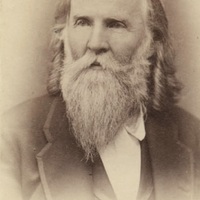 George Shepard Burleigh
 Freedmen, Aid to
 Suffrage, Woman
 Sonnet