

Sandip Roy
Journalist, Writer, Radio Host and Commentator
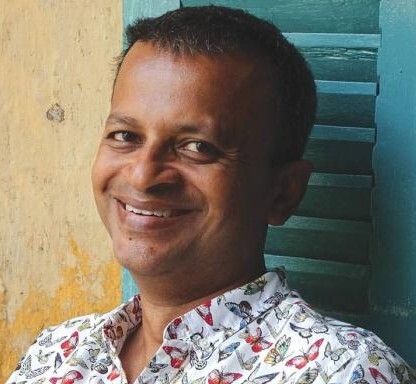
From Silicon Valley to Journalism
Sandip Roy came to the United States from Kolkata to pursue a master's degree in computer science and moved to the Bay Area in the early 1990s to work in Silicon Valley. For nearly a decade, he worked for software companies while writing on the side. With no formal journalism training or professional clips, Roy found his first opportunity at India Currents, where he began freelancing on arts and culture.
That opening would eventually change the direction of his life.
Roy credits the Bay Area with giving him the confidence to imagine a career outside the path he had originally chosen. Surrounded by immigrants, entrepreneurs, and people willing to pursue unconventional ideas, he began to see changing careers not as failure, but as possibility.
If I had not come to the Bay Area, I would never have been a writer. I just wouldn't have had the guts.
— Sandip Roy
In 2001, Roy left software to pursue journalism full time, accepting an editorial position with Pacific News Service/New California Media even though the job paid roughly one-third of his Silicon Valley salary. His first editorial meeting took place on September 11, 2001.
Finding a Voice in Community Media
India Currents gave Roy his entry into professional journalism. He began with freelance arts and culture reporting and remembers being sent to Fremont for one of his first interviews. Through India Currents publishers Arvind Kumar and Ashok Jethanandani, Roy also became involved with Trikone, the Bay Area organization serving LGBTQ+ South Asians, eventually becoming editor of its magazine.
The two publications introduced him to a form of journalism rooted in communities that often had little representation elsewhere.
Trikone was particularly significant. At the time, there were few spaces specifically addressing the intersection of South Asian and LGBTQ+ identities. The publication offered news, cultural writing, personal stories, community information, and a means of connection for readers who often could not find themselves represented either in mainstream LGBTQ+ media or in South Asian publications. Roy served as an editor of the magazine during the 1990s.
Looking back, Roy sees the eventual decline of the magazine not simply as a loss, but as evidence of how the community itself changed. As the South Asian LGBTQ+ population grew and the internet created new ways to connect, a single publication no longer had to serve as one of the community's few points of contact.
Connecting California's Ethnic Media
Roy's work with India Currents also brought him into New California Media, founded by journalist Sandy Close. The organization brought together newspapers, magazines, broadcasters, and journalists serving California's many immigrant and ethnic communities.
Roy recalled that Close recognized something mainstream media frequently overlooked: collectively, Chinese-language newspapers, Spanish-language publications, Indian American magazines, and other community outlets reached an enormous share of California's population. New California Media sought to make those journalists visible to one another and to the wider media landscape.
Roy became a regular India Currents representative at the organization's events and appeared on its television programming before joining Pacific News Service/New California Media as an editor and writer in 2001. The organization later became New America Media.
He also coordinated the organization's ethnic media awards, an extensive multilingual program that required entries from different language publications to be reviewed, translated, and judged. For Roy, the larger purpose was not simply recognition. It gave journalists working within different communities an opportunity to learn what other communities were reporting.
You really needed to pay attention to each other's stories because, in effect, they were all our stories.
— Sandip Roy
Finding Radio
Roy's transition into radio was another unexpected turn.
New California Media partnered with KALW, San Francisco's public radio station, to develop a program focused on California's ethnic communities. Roy initially appeared as a guest. When the original host did not work out, Sandy Close asked him to try hosting, despite his having no previous radio experience. KALW's Holly Kernan helped mentor him in the medium.
Roy went on to host programming associated with New California Media and New America Media, including New America Now, and also hosted KALW's call-in program Your Call.
Radio soon opened another door. Through his work at KALW, Roy began contributing commentaries and reported features to NPR's Morning Edition. He contributed pieces to the program, often combining commentary with interviews, ambient sound, music, and field reporting.
These pieces became a distinctive part of his work. Public-radio archives identify Roy as a longtime Morning Edition commentator, and his NPR reporting covered subjects ranging from Bollywood's growing popularity in America to immigration, family, food, culture, and changing India.
Between California and Kolkata
In 2011, Roy returned to Kolkata, initially planning to spend only a year there while helping care for his mother. Instead, the temporary move became permanent. He joined Firstpost, then emerging as one of India's early digital-first newsrooms, and began working within an Indian media organization for the first time.
Yet leaving California did not end Roy's relationship with Bay Area journalism.
A few years later, KALW approached him about creating a regular audio dispatch from Kolkata. The result became Dispatches from Kolkata, a continuing series in which Roy reports and reflects on contemporary India for listeners in California. KALW describes the program as a “letter home from his other home.”
For Roy, the format completed a circle. He had once reported on immigrant communities in California and their connections to places around the world. Now he could reverse the direction, telling stories from Kolkata back to the Bay Area.
I was sitting in one Cal, in Kolkata, telling stories for another Cal, in California. Both places...are really now part of my DNA.
— Sandip Roy
That position between two places has become central to Roy's journalism. Rather than simply explaining India to Americans or America to Indians, he is most interested in moments when stories unexpectedly connect the two.
One such story began when a KALW listener in Berkeley contacted him before traveling to Kolkata. Roy learned that she was part of the Chinese Indian community whose members had been interned in India following the 1962 Sino-Indian War. Her return journey eventually became a radio story and led to additional reporting. For Roy, the story existed precisely because his journalism connected Kolkata and California.
A Changing South Asian Bay Area
Roy has watched the Bay Area's South Asian population grow from a community in which cultural organizations and publications often struggled to find audiences into one large enough to support numerous cultural, linguistic, regional, religious, and social networks.
That growth has created opportunity, but Roy also sees a challenge.
As communities become large enough to create their own social and media ecosystems, he argues, they can also become increasingly insular. Journalists must therefore be cautious about anyone claiming to speak for “the community,” because there is no longer one easily defined South Asian audience.
For Roy, this makes cross-community journalism even more important. The goal is not simply to document the accomplishments of a community, but to preserve its complicated history and to understand how its experiences intersect with those of the people around it.
The history of the community is always a lot more complicated.
— Sandip Roy
The Bay Area and the Courage to Begin Again
Roy ultimately describes the Bay Area's greatest influence less in terms of a particular publication or institution than as a way of thinking. Silicon Valley was filled with stories of immigrants taking risks, creating new ventures, failing, and trying again. Watching people around him pursue ideas that might succeed or fail made his own decision to leave a secure technology career for journalism seem possible.
I had imbibed that sense in California of really infinite possibility that could exist within yourself and that you could try it. And if it worked, it worked. And if it didn't, it was okay.
— Sandip Roy
For Roy, that lesson shaped not only his career but his understanding of what journalism can do: create connections between communities, preserve histories that might otherwise disappear, and make room for stories that do not fit neatly within a single identity, country, or audience.
Featured Work
“Bollywood Dance Follows Movies, Music to the U.S.”
NPR, 2005
One of Roy's early reported commentaries for NPR examined the growing popularity of Bollywood dance in the United States. Rather than delivering a conventional studio commentary, Roy and an NPR producer recorded a Bollywood dance class at the Indian Community Center in Milpitas, incorporating interviews, music, and the sound of dancers into the piece.
Roy remembers this project as helping establish the audio-rich approach that would characterize many of his later NPR contributions.
“Indian Mangoes — Now in America”
NPR, 2009
After Indian mangoes became available legally in the United States, Roy turned what could have been a straightforward trade story into a sensory piece about migration, nostalgia, and taste.
He bought Indian mangoes from a Sunnyvale grocery store and brought them to San Francisco pastry chef Elizabeth Falkner for a comparative tasting alongside mangoes from other countries. Roy recalled that a Morning Edition editor later told him the mango piece became one of the program's most widely shared stories.
The published NPR piece, “Indian Mangoes — Now in America,” demonstrates Roy's ability to use an everyday object to explore the emotional and cultural connections immigrants maintain with home.
“A Brain Drain in Reverse, Back to India”
NPR / New America Media, 2009
Supported by a World Affairs Journalism Fellowship, Roy traveled through India reporting on a reversal of a familiar migration story: Indian Americans and other members of the diaspora leaving the United States to build lives and careers in India.
Roy interviewed both first- and second-generation migrants, including young people whose parents remained in the United States while they moved to India.
The project became a multimedia reporting package spanning radio, print, and online journalism, with work appearing through NPR, KALW/New America Media, and the San Francisco Chronicle.
For Roy, it remains one of the projects he is proudest of because it allowed a migration story to be told across several media at once.
“Danny Boyle's ‘Slumdog Millionaire’”
San Francisco Chronicle, 2008
As Slumdog Millionaire gained international attention, the San Francisco Chronicle's Datebook section asked Roy to anchor extensive coverage of the film and its cultural significance.
Roy interviewed director Danny Boyle and other principals involved with the film and examined what its popularity revealed about changing American engagement with Indian cinema and culture.
Roy remembers the assignment as significant because the newspaper turned to someone from within the South Asian community to interpret a major cultural phenomenon for its broader readership.
Dispatches from Kolkata
KALW Public Radio
After Roy returned to India, KALW invited him to continue speaking to Bay Area audiences from Kolkata.
Dispatches from Kolkata combines reporting, commentary, interviews, sound, history, and personal observation. The continuing series explores contemporary Indian life while frequently tracing connections between India, California, migration, politics, culture, identity, and memory.
For Roy, the series is not simply journalism about India. It is a continuing conversation between the two places he considers home.
Selected Recent Work:
“The Last Queen of Bengal”
KALW, August 12, 2026
In this Dispatches from Kolkata episode, Roy reflects on the life of Bengali female impersonator Chapal Rani (Chapal Bhaduri) and connects that history to his own years editing Trikone in California.
Roy describes how South Asian queer activists in the United States often looked for histories that connected contemporary LGBTQ+ identity to South Asia itself. Chapal Rani's life offered precisely such a history, although Roy did not know about him during his Trikone years. The story also connects to Roy's later biography of the performer.
The piece illustrates a theme that runs throughout Roy's journalism: recovering histories that complicate familiar ideas about migration, identity, culture, and belonging.