
War - Abolished by Universal Peace
Hark! —the cry of death is raging
Wildly from the reeking plain—
Guilty Glory too is flinging
Proudly forth her vaunting strain.
Thousands on the field are lying,
Slaughtered in the ruthless strike—
Wildly mangled, dead and dying,
Show the waste of human life.
Christians! can you idly slumber
While this work of Hell goes on?
Can you calmly sit and number
Fellow beings, one by one.
On the field of battle falling—
Sinking to a bloody grave?
Up! the God of Peace is calling—
Calling upon you to save.
Listen to the supplications
Of the widowed ones of earth!
Listen to the cry of nations
Ringing loudly, wildly forth!
Nations bruised and crushed forever
By the iron heel of War!
God of mercy!—wilt thou never
Send deliverance from afar?
Yes!—a light is faintly gleaming
Through the cloud that hovers o’er—
Soon the radiance of its beaming
Full upon our land will pour—
‘Tis the light that tells the dawning
Of the bright Millennial day,
Heralding its blessed morning
With its peace bestowing ray.
God shall spread abroad his banner,
Sign of Universal Peace—
And the earth shall shout Hosanna,
And the reign of blood shall cease!
Man no more shall seek dominion
Through a sea of human gore—
War shall spread its gloomy pinion
O’er the peaceful earth no more.
- Title
- War - Abolished by Universal Peace
- First Line
- Hark! —the cry of death is raging
- Creator
-
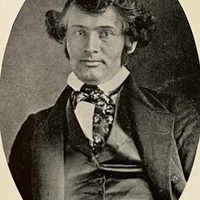 William Henry Burleigh
- Bibliographic Citation
- The Calumet 1.10.316 (November/December 1832).
- The Liberator, 3:2:8 (12 January 1833).
- Date
- 1832
- Period
- Early
- Subject
- War
- Peace
- Religion
- Comments
- Likely his first published poem - and in the two leading national journals for Peace (The Calumet) and Abolition (The Liberator).
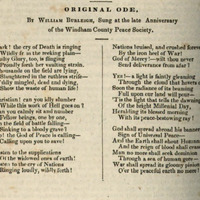
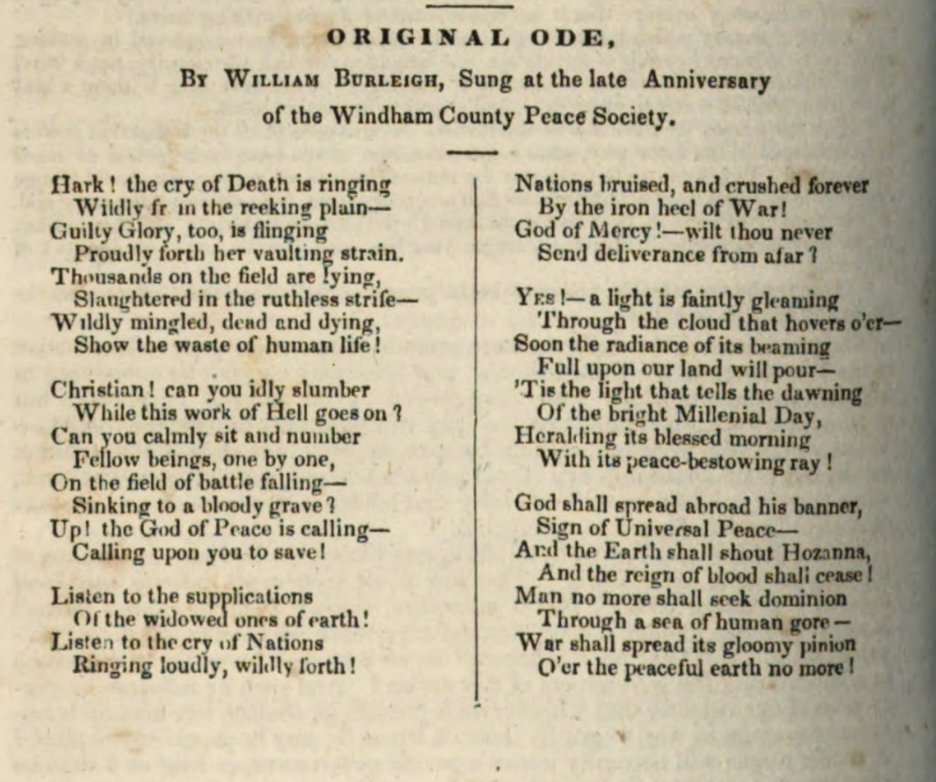
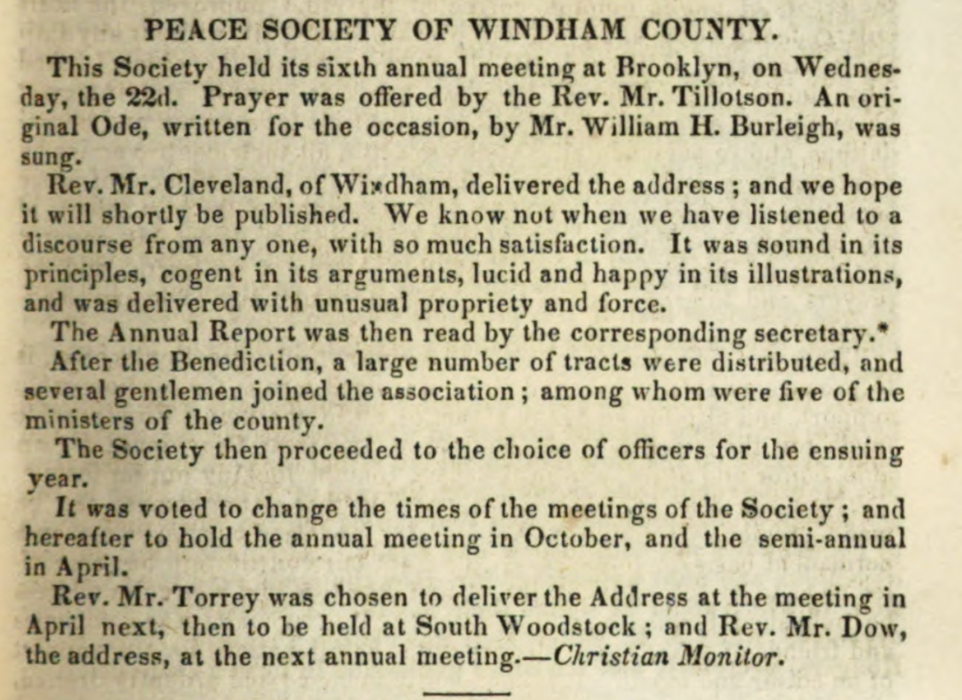
- Calumet published this poem under title "Original Ode." See enclosed image of this publication.
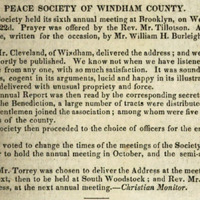
- William Burleigh read this poem at the Sixth Annual Meeting of the Windham County Peace Society in August 1832. See enclosed image of this event.
- Related Resource
- George Tillotson led the prayer at the meeting of the Windham County Peace Society at which William H. Burleigh made his poetic debut. He also played a role in the marriage of Prudence Crandall when the Episcopal clergyman refused.
-
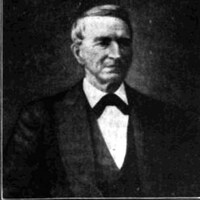 George Tillotson
- William H. Burleigh was a constant reviser of his poems. While the double sonnet entitled "War" and the sonnet "Peace" are clearly their own creative work, it is also very similar in its images and even the occasional phrase, to think this accidental. It is also, in combination, a more dramatic work, showing much greater technical skill as a poet. This double sonnet was included in the 1841 volume of William H. Burleigh's poems.
-
 War
War
-
Peace
- Rating
- ★★★