Yes, thou are right, sweet coz! I own
I am a lazy rhymer—very,—
And seldom give my harp a tone
Of willing music, sad or merry;
Its strings are snapped, or out of tune,
And I myself am out of fashion,
For wailing ditties to the moon
Was never my peculiar passion.
I never wet my thirsty lip
At Helicon’s inspiring fountain,
Nor even in fancy took a trip
To meet the Muses on their mountain.
The voice of Fame is sweet enough,
Doubtless, for devotees who love her,
But then her hill is quite too rough
And steep for me to clamber over.
Lazy and uninspired, can I
Write for thee canzonet or sonnet?
Or, smitten by thy beauty, try
To perpetrate a song upon it?
No—though thy charms of face and form
Would madden, like a heavenly vision,
When wine and love had rendered warm
Some dreamer of the fields Elysian!
No—though the wicked world should swear
Thou are the latest importation
From that bright realm where seraphs are
Bending for aye in adoration!
For beauty is at discount now
With the dull muse that weaves my numbers,
Nor laughing eye, nor polished brow,
Gleams on her in her dreamless slumbers.
But, for the brightness of thy youth,
And for the chastened love I bear thee,
And for thy gentleness and truth,
Which even thievish Time must spare thee,
And for thy heart which overflows
With kindness for the wronged and lowly,
And for thy guileless soul which glows
With tenderest feelings, pure and holy—
And for that fervent zeal for Right
Which burneth in thy bosom ever,
And for that steadfast faith whose might
In peril’s hour shall fail thee never—
For human sympathies, which bring
True hearts around thee to adore thee—
For these, dear coz! I kneel and fling
The tribute of my song before thee.
Others may sonnetize the spell
That lives within thy radiant glances,
And lying bardlings boldly tell
That loveliness around thee dances;
Vows may be offered thee in rhyme,
And worship paid in common metre;
But these will pass with passing time,
For beauty than the wind is fleeter.
Be mine the better task to find
For thee a tribute undegrading:
Flowers from the garden of the mind,
Fragrant and pure, and never fading—
Gems from the mines of knowledge won,
Brighter than fancy ever painted—
An offering to lay upon
The altar of a heart untainted
So, when the hand of Time hath reft
From face and form thy youthful graces,
A tenderer beauty shall be left
To sanctify their fading traces;
A chastened radiance, born of Thought,
Around thy path shall then be shining,
With more than earthly brightness fraught,
To gild and bless thy life’s declining!

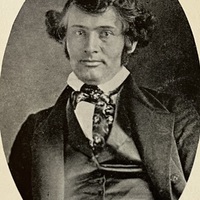 William Henry Burleigh
 To My Quaker Cousin