Once more in THY pure air,
With my pale forehead lifted to the sky,—
Wooing the winds which coolingly sweep by,
And on their pinions bear
The mournful music of the dying year—
Treading the herbage sere,
I walk abroad with feeble steps and slow,
And strive to leave behind my weariness and wo.
Thanks to Thy name, oh God!
That thou hast raised me from my couch of pain,
And led me forth again
To thrid the intricate paths which once I trod
With buoyant foot ere sickness laid
Its burning hand upon my throbbing brain,
And poured its fever-fire through every vein,
Until my days were made
Eras of agony. With exultation
Thrilling through heart and brain, I gaze around,
And my soul leaps, as from the flesh unbound,
Amid the wonders of this fair creation!
This is to live!—and yet I know I stand
Within thy shadow, Death!
Just on the borders of the Spirit-land—
And, ere the solemn Autumn vanisheth,
I shall lie down in darkness, where the light
Of sun or star comes not, nor breeze, nor bird,
Nor the low sound of running brooks is hear,
Nor forms of beauty flit before my sight,
Faintly upon mine ear
Comes a soft tone, as from another sphere,
Earnest, though low—I know that voice of doom—
It calls me from the scenes I love too well,
And soon, alas! must dwell
This shattered body in the noisome tomb!
Pour forth thy ceaseless song,
Fountain of leaping waters! pour it forth!
The music of the melancholy Earth
Will cease to me ere long;
Its wildering harmonies will all be hushed
For ever to my ear—the many tones
Which have in gladness on my spirit gushed,
Will be forgotten in my dying moans,
A few brief days of pain, and I shall pass
Even as the sparkling dew-drop from the grass
Kissed by the sun—
Spirits have called me—I must go away—
Their voices tell me that my transient day
Is almost one;
My life ebbs feebly to its final close,
And the grave proffers its serene repose.
Would that the birds might come
To join their voices with thy mystic song,
Glad streamlet! As thou sweep’st in light along—
But they, alas! are dumb;
And ever shall my raptured soul again
Thrill, like a harp-string, to their glorious voice—
Their deftly-woven strain
Shall make no more my troubled heart rejoice.
Would that the trees might put their blossoms forth
Yet once again while I remain on earth,
And scent the gales
With the sweet fragrance of their perfumed breath,
That I might drink their odor, even when Death
My frame assails!
Vain, passionate yearnings!—it can never be!
Spring may return in beauty—and the grove
Be vocal with the notes of joy and love,
But not again to me!
Flowers numberless may bloom
And pour their fragrance on the scented air—
They cannot cheer the tomb,
Nor soothe the sleeper in his slumber there!
The voice of waters, and the birds’ wild hymn
Will be the buried Poet’s requiem!
The fragrant breath
Of the unfolding flowers may wander o’er
My grave, but it can never gladden more
The home of Death!
Nature! thou dear and universal Mother!
Nurse of high thoughts and holy! I have felt
A filial love for thee, and humbly knelt
In worship at thy shrine! Nor can I smother,
Even in the grasp of Death, the fervent feelings
Caught from long converse with thee. Sweet revealings
Of thine exhaustless treasures have been mine—
Teachings of wisdom, such as human lore
Contains not in its many-volumed store—
And I have joyed to lay upon thy shrine
My soul’s affections as an offering—
Nor worthier might I bring;
For I have known thy baptism from a child,
Oh Mother undefiled!
Yet must I go from thee—
From thy still solitudes which my foot hath trod,
To the undreaming sleep beneath the sod,
Where reign the silence and the mystery
Of Death, the Conqueror! If my spirit shrink,
And tremble on the brink
Of that unfathomed Gulf which yawns before
My feet still clinging to Life’s crumbling shore,
It is not that I dread the pang intense.
Of dissolution. This must needs be brief,
And the fast-failing sense
Will bring the quivering flesh its quick relief.
Nay—‘tis the thought that I must part so young
From the bright scenes which I have roved among
With spirits dear,
Breaking the thousand tender ties which twine
Themselves around this yearning heart of mine
To bind it here!
I had not dreamed of this! Hopes—aspirations—
Intense desires, enkindle on thy shrine,
Ambition! had been mine—
And how my soul hath thrilled with exultations
When came the thought of immortality!
Yet, with the glorious heritage unwon,
Ungrasped thy guerdon, Fame!
Vanished my dreams, and crushed my hopes, my name
Unhonored and unknown—
So must the Poet ‘mid his visions die,
And pass away
From the bright things which now his spirit bless,
To the cold chambers of Forgetfulness
And dread Decay!
Tears will be shed and prayers be murmured only
By the fond few whose hearts are linked with mine—
For, with the great world round me, hushed and lonely
My life hath lapsed to its abrupt decline.
Still to the many, when my days are ended,
And this frail form with kindred dust is blended,
Earth will be bright as ever! Why should they
Weep for the lone Recluse, whose silent hours
Passed like a dream away?
Yet will one hand its tribute bring of flowers;
Daisies and violets, the first-born of Spring,
To scatter o’er my grave—Affection’s offering!
One of the world’s great crowd,
Whose lips have never breathed my name aloud,
Will keep my memory green for evermore
Within her heart—a treasure shrined and cherished,
Till the faint throbbings of that heart are over,
An darkly shall have perished
All that the earth hath known of loved or lover,
Leaving no trace on Time’s dim, crumbling shore.
Thus fades my brightest dream—thus darkly pass
The fairest visions which were wont to play
Like sunlight ‘mid the shadows of my way!
I wake to know that I am dust—alas!
Too near allied to earth!—No Child of Song
Over my grave will pour funereal hymn,
Or chant in solemn strain my requiem—
And the weird winds that wildly sweep along,
Will never bear my name
As one that dwells upon the human lip,
Though once I thought to hold sweet fellowship
Among the proudest of the sons of Fame!
Hopes—Dreams—Desires—of wild ambition born,
Whose dazzling light athwart my early morn
Streamed radiantly, and on my spirit fell
Like a fire-baptism—ye who long have shone
To blind, to wilder, as ye led me on—
Your lights have sunk in darkness—so, farewell!
But ye—divinest spirits! Faith and Love!
Sought long, and found at length—ye Cherubim!
Hushing the heart’s wild tumults with a hymn
Such as the angels sing in Heaven above—
We part not here!—for oh! have ye not told
Of the Bright City with its gleaming towers,
Its pearly gates, and amaranthine bowers,
And streets all paven with translucent gold?
Where shines nor sun, nor moon, nor twinkling star,—
But radiance brighter far,
Streaming from God, whose glory is its light,
Bars the approach of Night!
Thy radiant finger, Love!
Beck’ning thy votary from the troubled streams
Of earthly joy and sorrow, points above,
Where in unclouded splendor beams
The Sun of Righteousness!—and thou, oh Faith!
Hast promised me the victory over Death!
And henceforth shall ye be,
In life, in death, in immortality,
Companions of my devious way,
My guides from darkness to the full-orbed day—
Leaving me on through all the gloom of this,
To an unshadowed world of life and light and bliss!
Then, Harp! one more, one proud, exulting strain,
Thy last and highest, poured in joy to Him
Who led thee gently through the pathways dim
Of pride—ambition—reason—not in vain
Trod, since they brought me to a brighter way,
And purer light, and everlasting day!
To Thee, oh God! who gave the power of song,
And filled my spirit with imaginings
Of beauty, glory, from divinest things
Transfused into my soul—to Thee belong
My Harp’s expiring notes, triumphantly
Poured in thanksgiving, reverence, joy and praise—
And though the offering all unworthy be,
Accept, oh PARACLETE! the hymn I raise!
Thanks—that Thy light, though late,
Showered from on high, the clouds did dissipate
Which hung around me like a gloomy pall
Whose heavy shades threw blackness over all!
Thanks—that my spiritual eye hath been unsealed
And taught with strengthened vision to behold
Something of that high majesty which, of old,
Thou to Thy prophets and Thy saints revealed!
Glimpses of things divine
Have been vouchsafed me in my life’s decline—
And that pervading peace, whose still repose
Passeth all understanding! Thanks and praise
That Thou with choicest gifts hast crowned my days,
As they lapse gently to their final close!

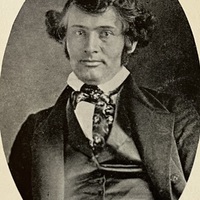 William Henry Burleigh
 Thanatymnos