MY COUNTRY!—waked by that endearing name
What mixed emotions thrill along my frame!
Love—apprehension—pity—shame—and pride—
Exulting—trembling—shall I praise or chide?
Hoping—yet fearing—as I turn my eye
On the far future of thy destiny
Haply to learn, to notes of joy or wo
Shall the rude numbers of thy poet flow?
Say, shall he sing of sunshine or of gloom?
A lay of triumph or a hymn of doom?
Shall the harp pour loud paeans for the dead,
Or mourn, in fainter notes, their virtues fled?
To the heart’s bidding, wake an anthem high,
Startling like thunder as the strain sweeps by;
Telling to willing ears of wealth and power,
Courage and freedom—still our glorious dower,—
Or with precursive numbers, sad and faint,
Fling to the answering air a dirge-like plaint,
Whose melancholy burden still shall be,
“In name alone, my county! art thou free!”
Land of the mountain, wilderness, and flood!
Whose soil hath been baptized in noble blood—
Land of the bold, free hearts, whose pilgrim-sires
Kindled her hills with Freedom’s altar-fires!
Land of my love!—the peerless ones of Earth
Might proudly claim thee country of their birth,
And from the old world’s crumbling dynasties
Turn, with new hope, to where thy hills arise—
The God-built fortresses, whose massive towers
Shook never to the invader’s hostile powers—
And here behold, beneath benignant sway,
Free as the winds that round their mountains play,
A vigorous race, from hardy fathers sprung,
Worthy to stand Earth’s proudest sons among!
O’er sunnier lands may bend a softer sky,
And statelier piles attract the traveller’s eye,
And thrill the pilgrim’s heart while looks he on
The fields where ancient valor fought and won—
Yet to thy children’s gaze no sun can shine
With more life-giving radiance than thine!
No gothic halls so dear as that which run
To the bold eloquence of Otis’ tongue
Or that—thenceforth to Freedom consecrate—
Where the stern fathers of the Nation sate,
Strong in their righteous purpose ne’er to cower
Before the British Lion’s bloated power—
Though menaced with an ignominious death,
Faltered not once their all-sustaining faith!
With piercing gaze upon the future turned,
Their fearless souls with holiest ardor burned,
When to their deathless Testament they gave
Names that shall live, though Nations find a grave!
‘Twas Freedom’s worthiest work since time began—
THE SACRED CHARTER OF THE RIGHTS OF MAN!
Though bloodier battle-fields his gaze may meet,
Who treads the classic East with pilgrim-feet—
Yet, if high courage in a holy case
May challenge fearlessly the World’s applause,
With glowing hearts we point to Bunker’s height,
Where beat the war-storm in its murderous might,
And British skill and discipline were taught
How strong the hand that for its altars fought—
How cheaply life was held for Freedom’s sake,
When both were periled in the dreadful stake!
In after times that crimson’d hill shall be
With reverence as out Thermopylae;
And, kept his memory for ever green,
In WARREN shall Leonidas be seen!
Not now we linger on each bloody strife,
The shock of armies and the waste of life—
Recount the perils that our fathers braved,
Till Freedom triumphed and the land was saved,
Justice prevailed and liberty was won—
We’ve our Platea and our Marathon!
Land of my fathers! nations, from afar,
Have watched the rising of thy natal star—
And while they marvel at its bright’ning glow
As streams of splendor from its full orb flow,
They tell its sudden doom with prophet-lips—
That o’er its disc shall come a dark eclipse,
Blotting the glory of its radiant prime,
Till men no more shall track its course sublime,
Nor speak admiring of the wondrous light
That on the nations burst, a Presence bright,
Scattering the gloom of ages—that its beams,
In darkness quenched, or changed to baleful gleams,
No more shall cheer the enthusiast devotee
Who prays and toils for human liberty—
And when that star shall set in seas of blood,
Oppression once again shall roll o’er Earth her flood!
Such is their sure prediction—shall it be
Fulfilled, my country! by thy sons in thee?
Earth’s despots, trembling on their thrones, await,
And wish and hope that such may be thy fate;
With hellish glee they watch for every cloud
That o’er thy sky rolls darkly as a shroud—
And shout exultant, as around thy shores
The maddened sea of lawless violence roars!
Nor with less anxious gaze, the good and wise,
Men of pure hearts and generous sympathies,
Intently mark thy progress, while for thee
Fate weaves a sad or glorious destiny:
They watch, alternating from hope to fear,
And pray that thine may be a bright career,
Undimmed by folly and unstained by guilt—
For Liberty on thee her hopes hath built;
If thou dost fail or falter, wo for men!
On Freedom’s altar-shrine no fires may burn again!
But if thy course be onward, freed from all
The base hypocrisies that now enthral—
If to thy glorious Charter thou art true,
And, strong in faith, the path of RIGHT pursue,
Till, rapt in admiration, Earth shall see
Thy practice with thy principles agree,—
Joy for the nations!—from the dust uplifted,
With new-born strength and courage strangely gifted,
They from his throne shall hurl the tyrant down,
Crumbling alike the sceptre and the crown;
Till Fraud, and Error, and their legioned lies
Shall shrink, despairing, from the lightning eyes
Of Truth, the child of God—and every land
Shall own her sway and heed her just demand;
All kindreds, nations, tongues, alike made free,
Earth shall become one Democracy,
And, like a golden girdle, Love shall span
The universal brotherhood of man!
The world hath groaned for ages ‘neath the sway
Of despot-powers and vilely flung away
Rights and immunities by God bestowed,
To bow its vassal neck to Slavery’s load
Until the once free spirit, bent to earth,
Bath lost the knowledge of its heavenly birth,
And—oh, its depth of degradation!—learned
To fawn around and kiss the foot that spurned!
But few, alas! have torn their shackles off,
And dared at kingly mummery to scoff;
Exposed the shallow sophistry that pleads
A wicked precedent for evil deeds;
Laughed at the lie that some are rulers born,
And poured on royal fools their bitter scorn!
Be their names honored!—let their memories dwell
In human hearts that high for Freedom swell,
And shout their watch-word in the tyrant’s ear,
Till, like Belshazzar’s, smite his knees in fear,
And on the wall, before his maniac gaze,
The red handwriting of his doom shall blaze!
Look o’er the Eastern World, erewhile the throne
When Science reigned, triumphant and alone!
ASIA, by TYRANTS crushed, by factions tost,
Now sunk in gloom, her early splendor lost,
From the Corea in Erath’s middle sea,
From Karskoi’s ice to Tritchinopoly,
Is spoiled by bandits and by despots cursed,
Her robber-kings “all evil, none the worst,”
Knowing of rights but little, caring less,
They live to kill, to plunder, and oppress!
Hapless SIBERIA! less cold thy plains
Than the stern tyranny that o’er them reigns!
Thy frozen winds are laden with the sighs
From many an exile’s breaking heart that rise,
And mingled prayers and curses stir thine air,
Breathing of hope, of anguish and despair!
Thy ranked vegetation, INDOSTAN!
Shoots less luxuriant than the tyrant-ban
That throws its upas-shadow, far and wide,
Over thy realm, where sits imperial Pride,
On vassal rocks upreared his gorgeous throne,
And veils the riches of the land his own.
CHINA, self-styled “Celestial” sits in dust,
As mean in weakness as in might unjust;
To powers that once she scorned compelled to bend,
But false and hollow-hearted to the end—
While beautiful ARABIA, erst the blest,
From robber depredations knows no rest.
Ill-fated AFRICA! alike the spoil
Of foreign knaves and scoundrels from thy soil—
Of petty chieftains and marauding hordes,
Whose aim is plunder and whose law their swords—
Of Christian slavers, who know not to spare
Or wife, or husband, youth, or hoary hair—
Of trading knaves, indignant Honor spurns—
Of canting priests, who pray and kill by turns—
Of robbing colonist, who, thieves at home,
Learned Christian ethics in the salt sea’s foam,
And now, with more than missionary zeal,
Spread their new faith with rifle-shot and steel,
And toil to found an Empire, broad and strong,
Whose base is fraud—whose superstructure, wrong;
Thus shall its record read on History’s page,—
“THE GRANDEST HUMBUG OF A HUMBUG’D AGE!”
Oh, Africa! since lost thine ancient glory,
How dark the pages of thy mournful story!
Though once the favored ones of Earth,
Now, thy unpeopled wastes but shadow forth,
Faintly, thy moral desolations! Yet
The sun, which long ago in darkness set,
Shall rise again, all radiant from the night,
And pour from coast to coast his refluent light;
Then shall thy sorrows cease, and end thy woes,
Thy desert places blossom as the rose;
And wilds, where once the cruel slaver trod,
Joy in new life—the gardens of thy God!
EUROPE—once shadowed by impervious night—
Hails the glad dawn of Freedom’s holy light;
Cloud after cloud in sullen gloom retires
From skies that kindle with the day-beam’s fires;
And soon o’er all her coasts, with burning rays,
The full-orbed sun of Liberty shall blaze,
And franchised millions hail their jubilee,
From Spain’s Sierras to the Northern Sea.
Not without sacrifice, sustained by faith,
Not without toil and trial, strife and death,
Shall thy great triumph, Liberty! be won—
The work perfected which thou hast begun;
For still the throne of Tyranny is strong,
And despot-powers combine to upheld the wrong
Fraction by fraction must the right be gained,
And with unceasing vigilance maintained;
Else all may fail, and in an evil hour,
Kingcraft regain its away, renew its power—
In fierce defiance lift its Gorgon-head,
And crush the nations ‘neath its iron tread!
See the grim Northern Bear, whose robber-paw
Still gathers States for his insatiate maw—
Before his march, shrink feebler powers away,
And Province after Province owns his away,
Is RUSSIA free! her nobles in their pride
Their chariot-wheels o’er prostrate vassals gride;
And POLAND, torn and bleeding ‘neath her ban,
Tells of her reverence for the rights of man!
NORWAY still cowers beside her frozen sea,
And SWEDEN bends to royal sway her knee—
Gleams but a doubtful light from Freedom’s sky,
Over thy vales and mountains, GERMANY!
Besotted AUSTRIA still churns the light,
And hugs her chains—while PRUSSIA , in the might
Of new-won knowledge, lifts her radiant heard,
On which thy sun, O Liberty! shall shed
Full soon its burning rays.
Capricious FRANCE!
Let who will fiddle, still thy sons will dance,
Nor shout their vives the less, not bluster more,
Though ruled by Consul, King, or Emperor!
What though thy limbs the gilded fetters wear?
Pleased with their glitter, little dost thou care;
What though thy once free press is stricken dumb?
A king to kill, or to a king succumb,
Hurrah for Bourbon, shout for Bonaparte,
Just as the whim suggests, prepared thou art.
Torn by contending factions, hapless SPAIN
Shrieks in her impotence and gnaws her chain!
Forgot the splendor of her ancient days,
When kings admired and poets sand her praise—
Forgot the glory of her Campador,
Tolosa’s story stirs her blood no more,
When, to direct the sanguinary strife,
The mighty dead were quickened into life,
And ‘mid the thickest fight exultant bore
Terror and death to the invading Moor—
Zamora’s peerless chief, who faltered not,
Beset by war and pestilence, forgot—
No more, to wake her slumbering chivalry,
Rings on the air Minaya’s battle-cry—
Vainly, alas! her patriot-bards may bid
Her pulses thrill with memories of her Cid—
While priest and despot rule with equal sway
Her abject sons, too willing to obey!
Degraded PORTUGAL!—the paltry stake
Of reckless gamblers who must win or break—
Her fame they little prize, her welfare, less—
No hearts have they to mourn her wretchedness!
The short-lived quiet of her peace to-day,
To-morrow’s rude convulsion sweeps away,
Changing her aspect with each changing hour,
As false in faith as impotent in power!
Turn, in disgust and pity, turn away
From States befooled and cursed with tyrant-sway,
And let the wearied eye a moment rest,
BRITAIN! on thee. Yet ends not here our quest
For righteous principles in practice sown,—
A People governed for its good alone.
Free but in part, thy peasantry are left
To toil through weary years, of hope bereft;
Tax piled on tax to bow them to the dust,
Imposed by laws impolitic, unjust,
They stagger on beneath the crushing weight,
And curse, by turns, the ministry and fate;
While princely nobles, in their selfish pride,
Waste on themselves the wealth by peasant toil supplied!
Yet, though indignant at thy children’s wrongs,
No maledictions tremble on our tongues,
For never can the generous heart forget
The vast and inextinguishable debt
Earth owes to thee—despite thy thirst for power,
Thou hast rained blessings upon man, a shower
Whose drops are more than rubies!—thou hast taught
The mind how vast its treasuries of thought,
And with unsparing hand to nations given
The Word of Life—the costliest boon of Heaven!
Ancestral land! from thee my fathers sprung—
To thee we owe this glorious English tongue,
Whose modulations, as they sink or swell,
Speak the strong language of the heart so well—
How to thy name, proud Land! my pulses thrill!
Britain! “with all they faults, I love thee still!”
Hope—sweetest prophetess—foretells the hour
When perfect liberty shall be thy dower
Tired of that glittering toy, a kingly crown,
Monarchs shall lay the worthless battle down,
Throw off the royal robe, the sceptre break,
Step from the thrones for Freedom’s worthy sake,
And own that men, o’er all the peopled earth,
Are equal brothers by a common birth!
Then shall thy poor no longer be oppressed—
Thy wrongs, chivalric Ireland! be redressed—
No more the many for the few shall slave,
Finding from toil no respite but the grave—
The fruits of labor to themselves returned
Eating the bread their industry has earned,
And blest with books and leisure—bold and free,
Shall stand in manhood’s pride, Britain’s strong peasantry!
Still darkly brooding over Ocean’s Isles,
Where Nature wears her everlasting smiles
In gloomy grandeur on his iron throne,
Reigns Tyranny supreme, but not alone—
Fierce Superstition with her demon-rites,
And eyeless Ignorance, whose base delights
Are found in darkness, rule their little hour,
The mutual aids and pillars of his power!
Nor in the Old World only, or where rest
The Ocean-Islands of Pacific’s breast,
Is man despoiled, and forced to bow his neck
And bend the knee submissive to the beck
Of pampered Power. With unimpeded sweep,
O’er mountain-heights, along the pathless deep.
Like the roused tempest, when the thunder-choir
Peals from the riven cloud, and quivering fire
Burns o’er this new-found World, relentless, flings
The baleful shadow of his outspread wings,
Shrouding its sunniest clime in deepest gloom,
Impervious as the darkness of the tomb!
Lo! The Republics of the South! where reigns
Fierce Anarchy, and throws o’er all her chains,
Crushing the weak ‘neath her demoniac sway,
Her will the law which all alike obey—
While Rapine, unrestrained, with robber-hand
Seizes and wastes the riches of the land,
And dread uncertainty each bosom fills
From Panama to Patagonia’s hills,
Until “Republic” has become a word
For Liberty to scoff at—loathed—abhorred!
Grown cunning, Tyranny may change its name—
Its demon-nature still remains the same!
What though in Freedom’s name it crushes man,
And human rights are placed beneath its ban?
What though, while wielding power usurped, it pleads
Democracy to sanctify its deeds?
Still ‘tis the same—the cruel—crafty—mean—
Through all disguise its scowling front is seen;
And where it breathes its pestilential breath,
Are fear, suspicion, misery and death!
From “the three fractions of the groaning” earth
Once more to thee, dear country of my birth!
I turn with mingled feelings. If the eye
Kindles with pride that reads thy history—
If throbs the heart exultant, while is told
The deeds our fathers dared, the true and bold,—
How in a holy cause they periled all,
And with their country vowed to stand or fall—
How, after years of peril, toil and war,
Broke through the battle-cloud sweet Freedom’s star,
And scattered o’er the land its radiance bright,
While happy millions hailed the long-sought light—
If memories like these the heart can thrill,
And with strange fire the eye, dilated, fill,
Well may thy sons, exulting, speak of thee,
Land of my love! whom Valor hath made free!
Reverent in thee thy patriot-children turn—
For thee and thine with prayer their spirits burn—
And oh! if gracious audience be given
When filial love provokes the ear of Heaven,
Blessings shall fall on thee, as falls the dew
On Hermon’s mount, thy beauty to renew;
Justice and Truth thy glory shall maintain,
And Peace divine through all thy borders reign!
Land of our hopes! the story of thy past
Makes the heart leap as to a trumpet-blast!
We tell with pride the prowess of our sires,
And listening children glow with kindred fires,
Catch the bold spirit, and with brightening eye,
Shout to the answering mountains “LIBERTY!”
And list with wildest joy the echoing sound
Form crag to crag exultingly rebound!
Oh, not in vain have martyrs on thy shrine,
Dear Freedom! bled—the triumph shall be thine,
Though now Oppression claims the earth his own,
And builds on human hearts his iron throne!
Not yet is Liberty extinct—not yet
The sun that rose above out land hath set—
Clouds for awhile its radiance may obscure,
But they shall pass—while purer and more pure
Glows the blest light, with healing in its beams,
And pours from land to land its lucid streams!
Shout! for the doom of Tyranny is spoken—
His yoke shall crumble and his gyves be broken!
Sighs wrung from aching bosoms, tears and blood,
Pouring o’er Earth, from age to age, their flood,
Shall cease their flow; and songs of gladness rise
Where once but groans and curses smote the skies;
And over lands the despot spoiled erewhile,
Brood dove-eyed Peace and linger Plenty’s smile!
Is it the dream of a bewildered brain?
Kindles the heart with such a hope, in vain?
No!—in our glorious CHARTER—richest dower
Of noble sires—a principle of power
Lives, that can shake the proudest despot down,
Wrest from his grasp the sceptre and the crown,
From fettered realms unlock the galling chain,
And give to man his plundered rights again!
Lo! panoplied for war hath Truth gone forth,
Not vainly missioned to the groaning Earth;
And what though Error strives, with fell intent,
To thwart the purpose whereto she was sent?
Fruitless the toil—his cunning schemes destroyed—
Truth from the field of strife returns not void!
In the hot conflict for the RIGHT, each hour
Hastens the downfall of unholy POWER;
Each onset brings the final triumph nigh—
Each foe subdued becomes a firm ally,
While feebler grows the hand that strikes for wrong,
And louder swells the exulting victor’s song!
Nor Freedom only shall the Nations bless—
But Knowledge shall increase, and Righteousness;
The pure religion of the Cross, no more
Baffled by despot-powers, from shore to shore,
Strong in the might of Love, shall win its way,
And bless the lands with its benignant sway!
Such is the picture to my fancy dear,—
But with our faith is often mingled fear;
And while the eye on present prospects dwells,
Though hope may live, alarm the bosom swells,
Lest the fair fabric by our fathers built,
Assailed by fraud and undermined by guilt,
Should totter to its downfall, and o’erwhelm
The hopes that cluster round Earth’s proudest realm;
For in our midst are subtle foes and strong,
Who joy in mischief and exult in wrong.
See PARTY SPIRIT—heartless—blind with rage—
And deaf to all that would her wrath assuage,
Reckless of right, propriety and law,
No love for justice, and for truth no awe,
Lies, libels, slanders, are her daily food,
And her thin, livid lips are bathed in blood.
From generous hearts, by alchemy accurst,
Wrung, drop by drop, to quench her sateless thirst!
From the base weapons which she joys to wield,
No purity of heart or life can shield ;
The brightest deeds she darkens with her scowl —
No name so stainless but her breath will foul ;
Intent on mischief, to the still recesses
Of private life with eager foot she presses.
Drags to the light her shrinking victim forth.
With demon-malice vilifies his worth, —
To wound the husband, stabs him through his wife,
And blights her name to blast his hopes in life, —
While brawling demagogues, with office paid,
Exult to see the ruin she hath made!
Sectional jealousies — divisions — feuds —
Fomented still by thoughtless multitudes,
And urged to wild extremes with maddened zeal,
Threaten to blight, ere long, our country's weal, —
Give a loose rein to Anarchy, and cheer
Disunion on in her insane career,
Till every tie of brotherhood is rent,
And wrought the ruin which her madness meant.
In vain the moral quack attempts a cure
That leaves the body politic impure—
Who strives, regardless of the right, to bind
A nation's wounds — blind leader of the blind —
With labor infinite and wondrous pain,
Compounds his nostrum-compromise in vain,
And pours with futile toil the nauseous stuff
Down strangling throats that gurgle out " Enough!"
Yet still are forced to gulp, in doses huge,
Or kill, or cure, the Clay-ey febrifuge!
Ye statesmen — sages — sciolists — whose trade
Is making laws, far better never made, —
See, in the past, and in the present, see
How worthless all your labor still must be,
While justice, mercy, truth, ye disregard,
And seek in robbery your base reward —
Forgetful of HIS law who sits on high,
That all are equal in the FATHER’S eye —
Forgetful, too, that Righteousness alone
Exalts a nation — or can save our own!
My native Land! amid thy cabin homes,
Amid thy palaces, a demon roams;
Frenzied with rage, yet subtle in his wrath,
He crushes thousands in his fiery path;
Stalks through our cities unabashed, and throws
Into the cup of sorrow bitterer woes—
Gives to the pangs of grief an added smart,
With keenest anguish wrings the breaking heart,
Drags the proud spirit from its envied height,
And breathes on fondest hopes a killing blight,
Heralds the shroud, the coffin and the pall,
And the graves thicken where his footsteps fall!
Ho! for the rescue! ye whose eyes have seen
The ruin wrought where Drunkenness hath been —
Ye who have gazed upon the speechless grief
Of early widowhood that mocked relief —
Ye who have heard the orphan's struggling sigh,
When, mad with agony, he prayed to die —
Ye who have marked the crimes and shames that throng
Like sateless fiends the drunkard's way along—
Ye who can tell his everlasting doom
When darkly over him shall close the tomb —
Up for the conflict! — let your battle-peal
Ring on the air as rings the clash of steel.
When rank to rank contending armies meet,
Trampling the dead beneath their bloody feet !
Up! ye are bidden to a nobler strife —
Not to destroy, but rescue human life —
No added drop in misery's cup to press.
But minister relief to wretchedness —
To give the long-lost father to his boy —
To cause the widow's heart to sing for joy —
Bid Plenty laugh where hungry Famine howls,
And pour the sunlight o’er the tempest’s scowls—
Bring to the soul that to despair is given,
A new-found joy—a holy hope of Heaven!
Yet other foes our country's peace assail,
Striving by fiendish cunning to prevail;
With ceaseless toil its broad-built base they mine,
And shake its pillars with a strength malign ;
Nor will their busy malice cease, till all
The superstructure totters to its fall,
Or public Virtue shall their rage repel.
And drive them downward to their native hell!
Lo! the Arch-Anarch, fierce Mobocracy,
Stalks o'er the land and shouts with demon-glee;
Trampling on law and right and public good,
He bathes his murderous hands in martyr-blood,
And lifts exultingly his hydra-head.
While shakes the earth beneath his iron tread!
Where his usurped authority is owned,
Mercy is scorned and Equity dethroned —
Before his footstool Weakness crouches down,
And meek Submission trembles at his frown;
Foul Treason, Murder, Arson, every crime
That curses earth or blots the page of time, —
These are his pastimes — and his devotees
Must bear the crimson stain of deeds like these!
No creed, no name, no rank avails to turn
His vengeance back if once his fury burn ;
No place is sacred from his murderous hate —
He rules, with sway alternate, Church and State,
And casts the Christian and the patriot out.
Who scorn his sway, nor echo back his shout;
And what cares he, if demagogue or priest
Do the foul work by which his power's increased?
Both for the wrong with different weapons strike.
And to his demonship are dear alike!
But see! — amid the crimes that call aloud
For vengeance, one pre-eminently proud,
Peerless in guilt, and stained with darker hue
Than common wickedness ever knew —
Concentering in itself all vileness, all
Of false or foul that can the soul appal;
Perfection of impiety — the last
And crowning work of Lucifer, outcast
Upon the earth — the spawn of deepest hell — (10)
A monster-birth without a parallel —
Lifts in our midst his horrid aspect, red
With innocent blood which his own hands have shed.
And claims, with scowling eye and haughtiest tone,
Tribute from all and fealty to his throne —
His throne, on crushed and bleeding hearts upbuilt,
By blood cemented and sustained by guilt.
To him, the statesman, with obsequious bow,
Gives up his manhood and performs his vow —
Before his footstool crouches in the dust.
And begs for leave to pander to his lust;
Obeys with vassal-soul his high behest.
And does his dirtiest work with keenest zest!
To him, the priest, a clerical poltroon,
Who fears that men will leave their sins too soon, —
Who weaves apologies for evil deeds.
And gauges piety by length of creeds —
Who pays lip-worship to the Lord of Heaven,
The while his heart is unto Mammon given —
Makes low obeisance, and with rapturous grin.
Opens his church to let the demon in ;
And at his bidding, with a wondrous knack,
Lies and blasphemes, and swears that white is black,
Perverts the Bible and the Cross maligns.
And all — Heaven help us! — with the best designs —
Greets him before the sacramental board,
Fellow-disciple of a common Lord,
And bids him take, with hands that reek with gore.
The emblems of His death who our transgressions bore !
Well may the land in which such deeds are wrought
Shudder with fear — God's vengeance sleepeth not !
Well may the nation, stained with crimes so deep,
Grow pale with terror, — and, repentant, weep!
Haply the Lord may turn aside his wrath,
Nor dash his lightnings redly in our path,
Nor bid his vengeful thunder o'er us break,
But spare the guilty for the righteous' sake!
May we not hope our Land, grown timely wise.
Will put away her foul impieties?
No longer rob the poor, no more oppress
The helpless, but awake to righteousness?
Live out her glorious principles, and show
A gazing world how radiant is their glow;
How vast their power for good, as back they bring
His primal dignity to man, and fling
A halo o'er the nations, in whose light
Earth shall rejoice, and own the reign of RIGHT!
Dangers, 'tis true, beset us — mighty foes
Mar our prosperity — our peace oppose —
And threaten to destroy : nor is it wise
From their existence to avert our eyes:
Yet have we safeguards — such as may avail
To shield our land from perils that assail,
Clothe us in heavenly armor, and make strong
To conquer hate and triumph over wrong!
LEARNING — that lifts the soul from sensual things,
And plumes the mind with upward-soaring wings,
Waits to bestow on all our land her dower —
A glorious gift of wisdom and of power;
A gift, the gold of nations could not buy —
Once ours, a world in arms we might defy.
Philanthropy — that yearns o'er human wo,
Comforts the sorrowing and uplifts the low,
Teaches — alas ! how little understood —
The soul the luxury of doing good,
Quickens the ear to list to Sorrow's cry.
And learn the "music of humanity" —
Oh, in her presence we may find a friend
Wise to instruct and powerful to defend —
The foe of Selfishness, that tramples down
Another's rights to elevate its own —
Of Pride, that turns on Poverty an eye
Cold with contempt and scorn, and dashes by —
Of Fraud, that struts in all the pride of place,
With cunning stereotyped upon his face, —
Of Slavery — foul epitome of hell —
Without a peer — without a parallel!
By thee baptized, divine Philanthropy!
Taught to relieve the suffering which we see.
Comfort the sorrowing and confirm the weak.
And in our neighbor's joy our gladness seek —
How strong in righteous power our land shall be!
How bold her generous children, and how free!
RELIGION, too — Jehovah's darling child —
Before the Father pure and undefiled —
With her meek teachings — with her hopes sublime —
With eye that pierces through the mists of time,
And sees the glories of the upper heaven
To patriarchs, prophets and apostles given —
With steady zeal that burns with constant flame —
Courage, that triumphs over pain and shame- —
In toil untiring, and serene in faith —
The soul's support amid the shades of death —
RELIGION, with her blessings, may be ours,
Surer defence than battlemented towers,
Than fleets with canvass wings expanded wide.
Than bannered armies in their martial pride —
A nation's glory, riches, power, defence —
The strength she blesses not is impotence !
So France was taught, when in her maniac-zeal,
She gave the Bible to the scoffer's heel —
Blotted her Sabbaths out — her ritual spurned —
The altars of her worship overturned —
With shout and song hailed Reason as divine,
And shrieked her frenzied orgies at her shrine!
"There is no God!" the drunken Nation cried —
"I AM!" His judgments terribly replied !
Taught by her folly, let us shun her fate —
'Tis Righteousness alone exalts a State,
And only that with permanence is blest
On which the blessings of Jehovah rest.
Oh, be those blessings thine, my native land!
Poured over all thy coasts with liberal hand;
And in thy perfect glory Earth shall see
All that thy patriot-children ask for thee.
Oh, such, dear Land! despite my filial fears,
Despite the cumulative guilt of years,
Despite the foes that hover round thy path,
And judgments waiting to outpour their wrath,
Shall be thy destiny! A vision bright
Dawns with refulgent glory on my sight!
As through the clouds, that lately veiled his beams,
Bursts the rejoicing sun, and pours his streams
Of golden light o'er all the laughing earth.
Its flowers to wake and call its beauty forth. —
Exult! — that vision brightens — 'tis of thee,
My glorious country! — I behold thee FREE! —
Guilt flings no shadow o'er thy wide domains —
No slave in hopeless anguish clanks his chains —
No nations robbed, thy broken faith proclaim —
No lawless rabble publishes thy shame —
Redeemed from all the follies of thy youth,
Thou standest in the majesty of truth,
A stalwart form, with vigor in each limb,
Without a stain thy lustrous name to dim —
Acknowledged champion of the rights of man,
Redeemer of the world from Slavery's ban —
The joy of millions, who in pride behold
Thy starry banner to the breeze unrolled —
The favored Land to whom all gifts are given —
THE PRIDE OF EARTH AND THE DELIGHT OF HEAVEN!

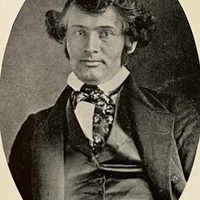 William Henry Burleigh
 Up for the Conflict