I.
Over the blackness of my hair
Comes the frost of age and care;
Streaks of silver intertwine
With dark locks, through which they shine
With premonitory gleam;
Prophets of the time are they,
Of the swiftly coming day
When shall end this fever dream,
And no more the busy brain
With its subtle thoughts and fancies,
The soul's wondrous necromancies,
Thrill to pleasure or to pain.
In the sluggish pulse, the slow
Life-tide, with its ebb and flow,
I can hear a murmurous sound,
As if from my soul's profound,
Whispering very sweet and low,
Spirits called me; low and sweet,
Pulse by pulse the words repeat —
“Linger not when bidden to go!"
List, my soul! that warning tone
Not of sadness breathes alone;
Something of promise, good and fair,
Something of prophecy is there,
Of a future which shall be
Better, brighter, holier far
Than earth's life can give to thee;
O, surpassing all we know
Or of good or pure below —
"Non Omnis Moriar!"
II.
Shadows, I know not how or why,
Day by day creep o'er mine eye;
And the fire that once was hid
Underneath the drooping lid,
Or, my soul with passion fraught,
Flashed the lightning of my thought,
Gleams but seldom now, and faintly:
Even the noon-day seemeth dim;
Hills, by brightest sunshine kissed,
Swell beneath a robe of mist,
Or in shimmering vapor swim;
And the trees by twos and threes,
Deftly shaken by the breeze,
Waltz to music, slowly, quaintly.
Ah, this treason of the eye!
Whence is it, or how, or why?
Tells it not that night is nigh?
The still night, unstirred by breath,
Through whose dark shines never a star,
The vague opaque which men call death?
Yet — "Non Omnis Moriar!"
III.
A quick coming weariness,
When with laggard pace I tread
Olden paths where once, as fleet
As the roe, I sprang to greet
The morn, dawning dim and red,
Now doth every limb oppress:
Wearily they follow still
The slow motions of my will,
Wearily, but soon give o'er:
Youth, with lithe and supple thews,
Passed as pass the morning dews —
Vanished youth returns no more!
Now I tread the solemn shore
Of that sea whose vastitude
Mortal eye hath never viewed,
Never mariner did explore;
And its thund'rous organ-roll,
Booming grandly from afar,
Pours its anthem on my soul,
With a many-voiced refrain,
Heard again — again — again —
"Non Omnis Moriar!"
IV.
As the dew that bends the grass,
As the breath that stains the glass,
As the morning's floating mist
By the fervid sunbeam kissed,
As the pageant of a dream,
As the lapsing of a stream,
As the hope that glorifies
Youth, and with its day-spring dies,
As the rapture which is sweetest,
As whatever thing is fleetest,
Life, with all that it can borrow
From the world of joy or sorrow,
All its petty conflicts o'er,
Passes, and is known no more.
Nay, one hope remains to bar
The despair that else would gloom
Over the portals of the tomb —
"Non Omnis Moriar!"
V.
Something of me, when men have said
“Speak kindly of him — he is dead!"
Something that doth appertain
To throbbing heart and thinking brain,
Shall, when I have passed, remain:
The memory of some sweet thought,
Or good deed in kindness wrought,
Verse of mine, perchance, impressed
With the love that fills my breast,
Or its woe and wild unrest,
Shall, enshrined in some fond heart,
Of its very life a part,
Live on, and with sweet constraint,
Hold it to my memory —
Thus "I shall not wholly die."
Then, soul! let nor pain, nor fear,
Nor the wrong that shadows life,
Nor hate, with which thou art at strife,
Claim the tribute of a tear,
Or the language of complaint.
Henceforth, naught thy peace should mar:
Deeper than thy fears or woes
Sinks the spirit of repose,
When triumphant faith can cry,
"From death I wrest the victory!
Non Omnis Moriar!"
VI.
But the heart must yield its trust,
And its memory be as dust
When, at length, it bows before
Earth's exulting Conqueror!
Earth itself (so prophets say)
In the flames shall pass away,
And the heavens together roll
Like a crisped and burning scroll,
And its myriad orbs expire
In a baptism of fire.
Yet even then the soul can cry,
"Nay, I shall not wholly die!"
From its place though earth be driven,
Though shall fade the stars from heaven,
Though the regnant sun be hurled
From his throne above the world,
And in fervent heat be blent
Every fusing element,
Still, outliving sun and star,
In a life serene and high,
Clothed with immortality,
Victor over death and hell,
I my triumph-song will swell,
"Non Omnis Moriar!"

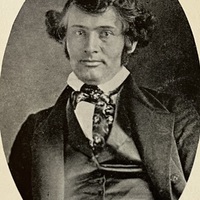 William Henry Burleigh
 "Non Omnis Moriar"