Too perilously beautiful! The world
For her had snares and pitfalls numberless,
And if she fell —
Nay, hide not with an if,
The hard, black fact, the sum of her distress,
Toppling her headlong from love's dizzying cliff,
Down — down — despairing — to shame's lowest hell,
"Where every memory is a pang ! She fell!
Ask not what radiant hopes with her were hurled
To that abyss, never to bloom again;
What hearts, made atheist, in extremest woe
Asked, "Is there a just God? " and answered, “No!"
What eyes, tear-blinded, looked for Heaven in vain,
Seeing that lurid horror everywhere, —
Above, around, — that smote them with its glare,
Till death shut down their lids and gave them rest.
She fell, poor Magdalena ! God, not I —
God, who knows all things, knows the how and why;
Knows, too, how long she strove, while sore beset;
How strong, temptation; how sincere, regret;
What tears of penitence, from day to day,
Have washed the sin-stains from her soul away;
What pardoning mercy, haply, hath been given,
In whose sweet peace she catches gleams of Heaven
And feels how He can bless, while erring man
With scorn would blast her, and with curses ban.
Whate'er she is, O scoffing Pharisee!
Whate'er, world-damned and lost, she yet may be —
Whether, grown reckless in her great despair,
She flouts all scorn, all paths of sin shall dare ;
Or, blotting out the past with bitter tears,
Give to contrition all her future years —
Remember this (and if thine arms caress
A child so dowered with dangerous loveliness,
Ask thou that God will keep and shelter her,
And O, be pitiful to all who err!) —
Once, she was innocent ! Ah, well-a-day !
How dirge-like sounds that once, — a funeral wail
Voiced in one word, since prayers nor tears avail
To build anew life's Eden swept away
By the strong floods of passion! Once, nor guile,
Nor sinful wish, nor perilous desire,
Nor love consuming with erotic fire,
Dwelt in her heart, the home of joy erewhile,
Of joy and chastity and sweet content.
And so her sixteenth summer came and went.
Songs rippled from her lips, and listening birds,
Her glad companions, sung to mock her words;
And the wildwood flowers caught a lovelier dye
From the warm sunshine of her laughing eye;
And gleeful children plucked her garment's hem
To ask for stories or a romp with them;
And very Nature, one would almost guess,
Thrilled, as if sentient, to her loveliness.
Seventeen bright years, whose every passing hour
Some gift of beauty, or of bliss some dower
Brought for her sweet acceptance — and she stood,
Eager, upon the edge of womanhood,
Filled with vague yearnings and prophetic fears,
That flushed her cheek and touched the fount of tears;
A troubled joy whose meaning scarce she knew,
Like fire electric thrilled her through and through;
And soon the truth that lurked in that surprise,
Shone with its tender meanings from her eyes;
And the white billows of her heaving breast,
Made the new power that swayed her manifest.
One rich in manly grace, and richly dowered
With gifts of genius, on whom fate had showered
Gold, fame, and all that gold and fame can bring,
With vague philosophies, bewildering
Her untaught reason; with delicious lies,
Named in our courtly language flatteries;
With vows that seemed a worship, sought to thrall
Her heart, till then a stranger to love's glow.
His words were warm with life, and sweet and low
Dropped on her ear — dropped, silver-musical,
On her unguarded soul, and waked at once
Within its depths such passionate response
As told him she was his — her law his will;
His, living, dying — his, for good or ill.
Needs not to tell with what a subtle power
He led her on, involved in dazzling mist,
To do, to be whatever he might list —
A pretty toy for passion's idle hour,
A splendid trophy of his dev'lish art;
Two words, condensing all she deemed of hell,
Sums the sad story of her life — she fell!
Awaked at length from the bewildering dream
That had enthralled her senses, shuddering,
She sees the serpent's coil, and feels the sting
Of dire remorse, that pours a fiery stream
Of shame and horror, anguish and despair,
Through every nerve and brain and heart and soul;
Till heaven grows black above her, and the air
Quivers with one vast curse, whose billowy roll
Swells louder, nearer, as if all that hell
Can hold of monstrous or of terrible,
With fiendish impulse, upward and afar,
Howled their fierce hate in one anathema.
In woman's gentle face she read the curse;
On manhood's lip 'twas charactered in scorn ;
And the young children looked with wondering eyes,
As 'twere a marvel in God's universe
That one so lovely should be so forlorn.
Nay. all the outer world seemed changed to her,
Even as the world within; and birds and flowers
And voiceful streams, and the vine festooned bowers
In the old woods beneath the summer skies,
And clouds and stars, once prompt to minister
To her delight, could charm no more her sense,
Nor soothe her soul with their sweet influence;
But all of Nature, heard or felt or seen,
Echoed the fearful words, "Unclean! unclean!"
-------------
Before mine eyes a vision of the past
Comes with a beauty perfect and divine,
Whose soothing spell is o'er my spirit cast.
I seem to tread the land whose every sod
Glows with the footsteps of the Son of God;
To breathe the odorous air of Palestine,
Where, 'mid her circling hills, set like a gem,
Shines the fair city of Jerusalem.
Not for the warlike pomp of Jesse's son,
Nor for the kinglier state of Solomon,
Nor for its temple rising silently,
A miracle of beauty, to the sky,
With cedar pillars and its roof of gold,
And splendors marvelous and manifold,
Remembered now: but rather that His tread —
The Man of Sorrows — left an impress there
Which made it holy, though He had not where
Amidst its thousand homes to lay his head.
I see the dark-browed throng around Him stand,
Cunning and hate and treachery in their eyes;
While, like a victim bound for sacrifice,
With cheeks that bum with shame, and drooping mien,
Waits with hushed breath the trembling Magdalene.
And the meek Teacher writes upon the sand.
See! as He lifts his sad rebuking face,
What scorn for them, for her what pitying grace
Is in his glance, which pierces through and through
The thin disguises of hypocrisy —
The tattered truth that wraps the specious lie —
And all their hearts are open to his view.
Not harsh, nor loud, but cold and passionless,
The words He speaks their malice to confound :
"Let him among you who is free from sin
Cast the first stone!" and. stooping, on the ground
He writes again.
Convicted by the stress
Of the stern monitor that speaks within,
Silently, one by one, they slink away
Like evil spirits from the light of day.
But O, with what divinest tenderness
His accents fall upon her soul and sense,
Who wept hot tears of shame and penitence,
The poor, wronged, sinning, sorrowing Magdalene,
And sweet assurance to her spirit bore
Of pardon, and of hope, and peace serene, —
"Nor I condemn thee; go, and sin no more"


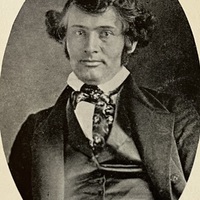 William Henry Burleigh
 Magdalena