“MOTHER, do let me go!”
The earnest gaze
Of the poor sufferer for a moment turned
Upon his mourning mother, and his eye
Had a beseeching eloquence in its light,
While the low music of his pleading voice
Pierced to the weeper’s heart. She bowed her head
Till his bright hair was lifted by her breath
And whispered, “Whither, dearest?” No reply
Came from the dying boy—yet still his words
Rung in the mourner’s ear, and thrilled her heart—
“Mother, do let me go!”
The damps of death
Were gathering on the brow of the beloved,
And the bright eye was fading. Beautiful
Even in his paleness lay the dying boy,
Gasping and quivering in the iron grasp
Of the Destroyer, while a plaintive tone
Came fitfully and faintly from his lips;
Heavily on his brain the burning hand
Of Sickness rested, and the mother new
Death lingered for his prey.
But yesterday
He was all life, and mirth, and happiness,
His mother’s idol, and his father’s joy,
Laughing and leaping in the frolic mood
Of happy, sinless childhood,—beautiful
As an embodied dream of Paradise—
His clear voice ringing on the floating air,
Like the rich music of the summer birds—
And his light footstep, as he bounded on
Through the wild paths around his father’s home,
Scace crushing the sered grass and withered leaves
That Autumn’s winds had scattered in his way.
Oh, how that mother, as she fondly gazed
On the wild pastimes of her fair-haired boy,
Felt her full heart dilate, and swell with pride
Which one but mothers now!—Oh how that heart
Yearned with unutterable love, as he,
Tired of his play, came bounding to her side,
To fling his white arms round her willing nec,
And press his soft lips in a kiss to hers!
Memory—away! why linger on the past?
Its blessed sunlight brings no radiance
To scatter present gloom. What is he now?
Death from his laughing eye hath snatched the light,
And set his signet on his baby brow!
The pallid lip is moveless—never more
Will it in joy or sorrow, lovingly,
Murmur—“Dear mother!”
In a quiet spot,
Where, in the Spring-time, sweetest wild-flowers bloom,
And the glad birds pour out their roundelays—
Just as the sun was flinging his farewell
Over the joyous earth, with many tears
They bore him to his rest, and lightly fell
The gravel on his coffin.
The wild winds
Will sing his requiem, and the driving sleet
Cling to his grave-sod—yet his dreamless sleep
Will not be broken!
Weep—thou desolate one!
Well—broken-hearted mother! for thy child
Sleeps in the grave’s cold keeping! Yet, in grief,
Forget not Him who chasteneth in love,
He on the wounded heart will greatly pour
The healing Gilead of his GRACE DIVINE—
Till in the fulness of a grateful heart
Chastened, but thankful, thou shalt bless the day
Of thy bereavement, and in patience wait
The hour thy spirit shall rejoin thy child’s,
In that bright world where Sin and Death are not!

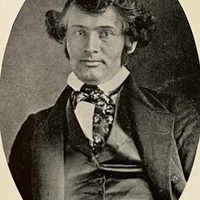 William Henry Burleigh
 Harriet Adelia Frink Burleigh
 "Let me go"