Agatha.—Nay, be thou not thus moved. I am not wont
To read disquiet in thy gentle eye,
Nor see thy brow thus clouded. Time will bring
Balm for this wound, and all. Have we not left
Manifold blessings yet?—life—health—our babe—
An, more than all, the love which maketh life
An Eden full of untold bliss, and paints
A rainbow on the cloud which even now
Casts o’er our path a shadow? Oh, beloved!
Having but thee, and living in the light
Of thy clear eye, and feeling that thy love
Like a sustaining spirit dwells with me;
And Earth—ay, even its darkest, dreariest spot—
Is full of beauty, and the woes which prey
On hearts less fraught with the prevailing power
Bestowed by Love, sit lighter upon mine
Than starlight shadows on the dreaming flowers.
Cheer thee, my Herbert! Let thy forehead wear
Still its serene expression, and thine eye,
Filled with the deep soft light of other days,
Beam on me still in tenderness, and Fate
Can throw no shadow o’er us. Even the clouds
Will glow with brightness, and the darkness wear
A radiant look for us.
Herbert. Sweet prophetess!
Life is to thee all sunshine, and thy heart
Yet knoweth nought of agony. Oh God!
But for the fate which linked thy life with mine,
And thy young soul with gladness still had held
Blessed companionship! But now the hand
Which should have led thee unto deeper springs
Of human bliss, and sheltered thee from ill,
Must hold the poisoned chalice to thy lips,
Till thy faint spirit staggers, drunk with wo!
Why did we meet? A curse be on the day!
Agatha.—Oh Herbert, curse it not! Did not the heavens
Smile on us when we stood with clasped hands
Beneath the holy starlight, with our eyes
Uplifted meekly to the firmament,
And our lips quivering with a voiceless prayer?
Then fell a blessing like the balmy dew
Upon our asking spirits, till they thrilled
With its pervading presence! Love and awe
Were mingled in our souls, as there we knelt
And pledge our earnest faith, while the calm sky
Looked down upon us with its myriad eyes.
Curse not that hour, my Herbert! Oh how fraught
With deepest blessings to our trusting hearts!
And not a shadow o’er the sky of love
Hath come since then. Then bear thou nobly up,
Oh, best beloved! and this dark cloud shall be
Soon overpast.
Herbert. And is it then a thing
Too light to move the soul of Agatha,
That Treachery, wearing the familiar robe
Of Friendship, that our hearts should bid him come,
Steals to our hearth and robs it of the joy
Which lived in our abundance?—is it nought
That we are stripped of all, and from our home—
The sanctuary of our wedded love—
Driven out friendless?—that our sinless babe
Is made an heir to beggary and want?
An, as the Fiend of Evil asked for more,
Dishonor, deep and damning, o’er my name
Dashed like a crimson stain?
Agatha. Believe it not!
Malice itself shall never dare to breathe
Of shame to my own Herbert. We are poor,
But not dishonored—not a stain is thrown
O’er thy fair name. Unsullied, it shall be
Better to thee than wealth.
Herbert. My Agatha!
God shield thee from the storm, for it must come!
Thou knowest not how changed the world will be,
When of our poverty the tale is told—
How coldly those who at our board have sat
Will look upon us. The averted eye—
The curl’d lip of derision—the cold sneer—
The heartless laugh—the mean suspicion, shown
In shrug or start—all these thou yet must know;
And these are but the preface of the stern
And bitter lesson Poverty will teach.
Agatha. Doubter! thou knowest not the power of Love,
The fervor of its faith, if thou canst deem
Such things can e’er appal it. It hath met
Hatred, and scorn, and shame, and agony,
Nor quailed at the companionship, nor shrunk
From the fierce trial of its inborn power
To dare or suffer.
Herbert. Not for thee, dear one,
Was suffering made. I know thy love is strong,
And quenchless as thy soul. But the rude wind
Hath never swept thy spirit till its chords
Wailed like a broken harp-string—nor hath We
Laid his hot hand upon thy throbbing brain,
Till Madness murdered Reason, and Despair
Sat on the grave of Hope. The agony
Which gnaws the heart like fire, thou hast not known,
And canst not know and live. Thy power to bear—
Not the frail spirit’s willingness—I doubt.
Agatha. Faithless and slow of heart! doubt not the power
Given by Love and Faith to Woman’s heart.
Hath it not conquered agony and shame,
And nerved the weak to venture unappalled
Into the presence of consuming Power?
To stand unmoved and wipe from pallid brows
The death-damps, anguish-gathered?—to sustain
With words of high endurance and calm faith
The strong of heart, when fainting?—and to lure
Back from Despair the mighty, when their power
Is torn away, and Scorn hath set his heel
Upon the fallen? What Woman’s love hath dared,
Thine Agatha’s will dare—what she hath borne,
I, weak and frail, can bear.
Nay, look not thus!
But for this gloom of thine, my soul should rise
In thanks to God, that he hath brought a shade
Over our paths. Now thou shalt know how well
I love thee, Herbert. While our way was strown
With roses, giving fragrance to our tread,
And the glad sunlight of continual joy
Was in our eyes, and blessings were rained down
Upon our heads profusely, what could try
The faith of a young, trusting, loving heart?
Now that our road is thorny—the glad sun
Hideth his light awhile—and we must feel
The Chastener’s hand upon us—thou shalt know
The priceless treasure of a woman’s love,
Till in the fulness of thy noble heart
Thou shalt bless God for this thy suffering,
That it hath taught thee what a wife may dare
For him her heart adores.
Herbert. I will not throw
A chill, dear Agatha, upon thy breast,
Nor check thy sweet enthusiasm. The light
Of thy faith-strengthened spirit may grow dim,
But cannot wholly die. Its fires are fed
From heaven’s eternal altars, and thy God
Shall give thee strength proportioned to thy need,
Go—thou hast given me a sustaining power
For future hours of trial. If thy soul
Be thus upheld, mine shall not feebly shrink
Before the gathering tempest.
Agatha. Now I know
Thou are my own proud Herbert—for I see
Thy strong soul beaming from thy glorious eye,
And the firm lip curled slightly with resolve,
The gloom hath left thy brow—nor shade is there,
Save of thy dark, damp locks. Thou lookest now
As when with playful fingers I would part
The soft hair on thy forehead, and with joy
Too deep for words, gaze long and earnestly
Upon its broad white surface, till I deemed
I read it as a book, and my fond lips
Drew near it tenderly—as now—until
Their fervor melted—thus—into a kiss!
Herbert. —God shelter thee, my lamb! Adversity
Draweth thy soul more closely into mine.
Not now I speak my thanks—yet thou shalt now—
The Future shall reveal it, Agatha—
Thou hast not poured the treasure of thy love
Upon a worthless shrine!

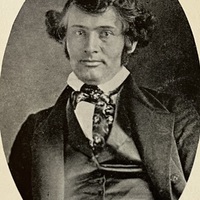 William Henry Burleigh
 Harriet Adelia Frink Burleigh
 Harriet