
Childe Harold
In sooth a melancholy wight was he,
As forth he went from home and native land,
Leaving his own for some far foreign strand,
A sullen wanderer on a sullen sea.
“I have not loved the world, nor the world me,”
Said the sad child, and darker gloomed his brow,
And on his lip sat scorn, as o’er the prow
He went to watch the wild waves in their glee—
How did they image forth his own unrest!
Not wilder than the passions in his breast,
So passed he on, and oft his pilgrim tread
Echoed ‘mong classic ruins—of the stood
On some old fields baptized in patriot blood,
And hallowed by remembrance of the dead—
And oft in dungeons, whose cold, slimy walls
Had once held hearts no torture could subdue
True to themselves and to the FUTURE true,
Triumphant over terror that appals
Souls less sublimed—earth’s weak and willing thralls—
And on the graves of empires overthrown,
Whose sorrows made him half forget his own,
What time he mused amid the crumbling halls
Where Desolation reigned. At length he heard
Greece cry for succor—and that thrilling word
Kindled with touch electric soul and sense!
So did he link his own immortal name
With her immortals— and she keeps his fame
As one who toiled and died in her defence!
- Title
- Childe Harold
- First Line
- In sooth a melancholy wight was he
- Creator
-
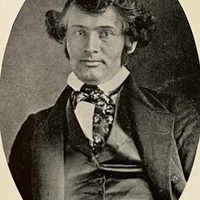
William Henry Burleigh
- Bibliographic Citation
- Graham's Magazine (Philadelphia) 23:1:181 (July 1843).
- Date
- 1843
- Period
- Middle
- Subject
- Heroism
- Poetics
- Lord Byron
- Comments
- An homage to Lord Byron, with emphasis on his assistance to the Greek cause for freedom
- Written as a pair of connected sonnets
- Rating
- ★★★★
- Media
-
Childe Harold