An old man stood on a precipice-verge—
A gray old man was he;
And a saddened light was in his eye,
As the mourner wind went sighing by,
And his glance was on the sea:
Below his feet was the warring surge,
Where the created waves each other urge
In fury and wrath to the ragged rocks,
That quiver not to their mighty shocks,
However fierce they be.
Bowed with age was the old man’s form,
And his cheek was deeply ploughed
With the share of Time—or haply, Thought
On the old man’s face those furrows wrought,
While his bearing yet was proud;
For the blood of Youth may still be warm,
While the brow bears record of many a storm
That the torture thought has known within,
When the quickened spirit fought with sin,
Or the woes that on it crowd.
Quaint was the dress that the ol man wore,
For a queer old man was he;
His bony legs were crowded in
To tight small breeks of a white bear’s sin,
All buckled at the knee:
A blanket was flung his shoulders o’er,
And pinned with icicles up before;
Like a thin snow-wreath, above them all,
Gleaming and bright, was a shadowy pall:
‘T was a solemn sight to see!
With a troubled mind, the old man thought
On the waves that foamed below;
He tottered along to the farthest verge’
Of the slippery rock, and viewed the surge
With an aspect full of wo:
What in the deep the old man sought,
Legend or lay revealeth not;
But his gaze was long, and his eye grew dim,
Till in blinding tears it seemed to swim”
Why wept the old man so?
Over his head was a broken tree,
Killed by the lightning-stroke;
And an owl sat there with half-closed eye,
And poured on the air his boding cry,
Till the mountain echoes woke:
And, floating over the solemn sea,
A mournful dirge it seemed to be—
A mournful dirge for the buried dead;
And sadly the old man raised his ehad,
And feebly, faintly spoke:
“The death-song of the Year!
It tells me that my errand here is one,
That I have gazed upon my latest sun‚
What further do I here?
Trembling above the ocean of the Past,
Yet feebly clinging while my moments last—
“Clinging to Life—in vain?—
The deep see yawns before me—
T in the grave
Of vanished Years. Oblivion’s turbid wave
Flings not to light again
The buried treasures of the olden times—
Rolling alike o’er Innocence and Crime!
“I go—and as I die,
The gay will laugh, forgetful of their doom,
Frolicking on the borders of the tomb
In thoughtless revelry:
Let then sport on beneath their sunny sky;
Too soon, alas, the storm will hurtle by!
“In the lone closet now,
Clasping the hallowed Book, the good man kneels.
Communing with the Past, while faintly steals
Across his placid brow
The mournful light of memory, soft and dim—
Oh, holy treasures hath this hour for him!
“With love that cannot tire,
The mourning mother by the cradle-bed
Watches her wailing infant, while its head
Burns with the fever-fire!
The cold gray morn will come and find her there—
The living with the dead—Death and Despair!
“The giddy world wheels on,
Unmindful of the lessons of the Past;
Yet one more warning—it will be my past—
The Old Year’s dying tone;
Mortal! we meet again: so live, while here,
That you may all your last your happiest year.”
--------
The old man paused—for the icy rock
Quivered beneath his tread;
An angry scowl came over the sky,
And a sudden earthquake thundered by—
‘Twas an hour of fear and dread!
The tall old mountains felt the shock,
And the sea heaved up, as if to mock
The old man’s terror and despair,
As he gurgled out his dying prayer—
And THIRTY-SEVEN was dead!
--------
Trembling, quivering on the air,
Like the solemn voice of prayer
Herad amid the forests dim,
Rose a low and mournful hymn—
Faintly now, as if its tones
Trembled into dying moans,
Or were almost hushed to peace,
Waiting for the soul’s release—
Then again in triumph swelling
Upward to the spirit’s dwelling,
Ringing through the clear blue sky
With a sudden melody!
‘Twas the requiem of the Year,
Chanted in another sphere!
Fairy harps were faintly ringing,
Elfin voices low were singing,
While the spirits of the air
Poured their willing music there;
And, if rendered not amiss,
Something was their song like this:
“Oh, weep for the Earth and the children of men!
Awake the sad music of mountain and glen!
Pour out the deep voice of lament on the blast,
For a Year hath gone down to the grave of the Past!
“A Year!—and the Earth waxeth old in its sin,
Though the fires of destruction burn hotly within;
Though her end draweth near, and the time will not wait
When the voice of the Spoiler shall sound at her gate!
“Lament! for the Year, with its promise of bliss,
Hath gone from a world full of mourning like this;
And the hopes that it brought have been trampled in dust,
And its paths have been paved with the hearts of the just!
Rejoice! For the day of redemption draws nigh!
Let loud hallelujahs resound through the sky!
Let the Years roll away, and the darkness shall flee—
Rejoice and exult, for THE EARTH SHALL BE FREE!”


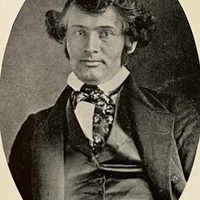 William Henry Burleigh
 1837. A New Year's Fancy