Bright morning in the east comes forth
[FIVE OBSCURED LINES]
He forward casts an ardent glance,
With beauty beaming in his face
All radiant with the light of love;
And hastening from his home above
He meets here with a fond embrace
Upon the sloping mountain-side;
And, from the fair cheek of his bride,
He wipes away the tears of dew,
Which Night with rude advances drew.
And see in younger glen so fair,
He hath raised her delicate veil of mist,
And while the rose-blush mantled there,
Her blooming cheek in rapture kissed.
The woodlands scattered round about,
Have flung their shadowy foliage out,
To veil the glorious temple, where
The thousand songs of gladness rise,
Stirring the morning’s balmy air
With all their blending melodies;
And wide, their leafy skirts between,
The meadows show in lighter green,
Where, half concealed upon its bed,
By the long grass o'er-canopied,
The modest violet droops its head;
And yellow daisies deck the ground,
Which strown along the verdant vale,
Like fairy legions scattered round.
All panoplied in golden mail.
Oh! beautiful is the forest now In summer's green array,
As pours, o'er every waving bough,
The golden food of day.
The aspen's quivering leaflets dance
To the song of the passing breeze,
And brighten, in the sunbeam's glance,
The dark-spired cedar-trees.
Deeply the tall pine sighs in the blast,
To find that summer hath come at last,
And its day of unrivalled green hath passed;
[ONE LINE OBSCURED]
New-crowned with a leafy diadem,
It shakes with glee at the gloomy old tree,
Which once looked on it so scornfully.
The mulberry opens its golden leaves,
Yellow as Autumn’s ripened sheaves;
And the maple lifts its head to view,
But colored, with a deeper hue;
The graceful elm, the pride f trees,
Flings its lithe branches to the breeze,
Half up the mountain’s rugged side,
The tall ash stands erect in pride;
And all along the hill, is spread
The chestnut with its leafy head;
And there the firm rock-rooted oak
Shakes oft its branches to the storm,
As in defiance of the stroke
Which thunders through its knotty form.
Amid the leafy boughs of June.
The birds pour out their merry tune,
The mingling songs of grateful praise,
In varied, bat unceasing lays.—
The robin chirps upon his tree,
In answer to the chick-a-dee,
The cat-bird, bobolink and quail
Sing to each other in the vale;
Around the cottage-home are heard
The little wren and chirping-bird;
And on the barn, the purple dove
Is whispering to his mate of love.
From flower to flower the hum-bird flits,
The blue-bird on his walnut sits,
And on the shady hazel bush
Melodious sings the merry thrush;
The twittering swallow cleaves the air,
Wheeling in swift gyrations there,
The thieving owl, till day is gone,
Creeps to the marshes, dusk and low;
And from the growing fields of corn
The king-bird drives the coward crow;
High hovering on extended vans,
Or swimming through the liquid way,
The robber hawk the farm-yard scans,
Searching with eagle eye his prey;
And when the sleeping earth is still.
And every voice of day is dumb,
The glad notes of the whip-poor-will
Along the cool air come ;
And urchins gaze with wonder brief
To hear the night-hawk crying "beef!"
Thus. From the matin of the lark,
Until the sunless heaven is dark,
The thousand warblers pour their song
Into the listening ear of Day;
And, as his chariot rolls along,
Sing still the merry hours away;—
Breathing their sweet-linked harmonies
In ever-varying tones, that rise
To heaven, with every mystic word
Fast echoed by the mocking-bird;
While sterner children of the air,
With cruel talons seize their prey;
Or, hiding from the morning’s glare,
Await the hour of dying day.
There’s glory on the green hill-top,
And glory on the plain,
As the golden sun is lighting up
The awakened earth again.
The fields of rye on the plain are seen
Like ocean bays, with their waves of green;
The gallant breeze it kisses the rye,
And the rye it bows to the breeze;
And the swift cloud-shadows across it fly,
Like ships over rolling seas.
The cattle, led out to a hundred hills,
Have drunk their drink from a thousand rills,
And are cropping the herb-feast, Nature spread,
So sweet and fresh with honey-dew made,
And left for them in the cooling shade.
The chubby boys and the roguish girls,
With their rosy cheeks and sunny curls,
And the bright and sparkling eye,
Along the way are they loitering,
Hearing the feathered warblers sing,
And talking to each living thing,
Or starting up, on painted wing,
The little butterfly.
And it is well: be not the mind,
Tender and young, to books confined;
But let the youthful spirit rove
Among the varied works of nature,
And on the plain, or in the grove,
Hold converse with each living creature.
Better to talk with birds and flowers,
And sport upon the sunny lea,
Then kill in school the heavy hours
Which drag along so lazily,
Where the infant soul is cramped and froze
At the first of its young up-swellings,
[TWO LINES OBSCURED]
Then may the child[?], made strong and free[?]
By the communion with the things
Of Nature, grasp the mystery
Of Learning, and on tireless wings,
Fly o’er the fields of Science fair,
Perchance where soul hath never ????
And, revelling in the vastness there
Lay open regions unexplored;
While they whose youthful souls are bound
To stupid books, for thought, must plod
Their way, along the self-same ground
Their sires and ancient grandsires trod.
Let children sport:—I love to see
A merry girl of eight or ten,
Tripping about in sinless glee,
Along the rosy glen,
And, on the bough of the old oak tree,
Swinging light and gracefully,
Or bounding over the whirling rope,
With a buoyant step and free,
Or talking, on the green hill-slope
With the sweet-songed chick-a-dee.
A starry eye and a cherry lip,
A rosy cheek and floating curls,
A free-tossed arm and a bounding skip
Are Nature’s gifts to the fair, wee girls,
Which, stolen in childhood’s prison away,
Return to bless us no more for aye.
And sweet to hear are their laugh and shout,
So loud, yet musical, ringing out:
They tell of pure and innocent joy,
Which books and the school should not destroy.
But oh! what more can one despise,
Than the quirk and twist of the half-shut eyes;
The little mouth, put up "genteel;"
The mangled words, and the laugh-by-rule
Of the simpering doll of whom they feel
So proud, they have made it a mincing fool;
Prating in French, while yet so young
She can scarce recite in her mother tongue;
Lisping it out just thus and so,
As she reaches up to the knee of a beau;
Or dropping, over the "Sorrows of Werter,"
One little tear, for the lover's woes,
And, lest that little tear should hurt her,
Applying the “Eau de Cologne” to her nose
[ONE OBSCURED LINE]
Should try his hand at improving Nature;
But not so strange if when they try it,
They spoil the ??? ??? by it.
Her’s is the ??? ??? and fair,
Of the soft-hued[?] Daguerreotype,
And though as outward ?? be there,
No touch of human hand may wipe
The blemish from the ??? plate,
Lost, marred, its hues rekindle never,
And man is left to mourn, too late,
The living beauty lost forever.

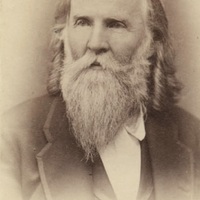 George Shepard Burleigh
 Woodland Dreamer, A