‘The Powers that Be Are Ordained of God’
The spirit of violence goeth abroad,
Triumphantly ploughing through rivers of blood;
Oppression is clanking his letters of iron,
And treachery stalks in the militant zion,
And the strong arm of law is wielding the scourge
O'er the nations of earth, to its farthermost verge:
But let them rejoice in the dust to be trod,
For "the powers that be, are ordained of God."
The millions of Russia are bending the knee,
Where nought but the cold blowing breezes are free;
Submissive they bow, as the autocrat becks,
And are kissing the dust with his heel on their necks;
The hearts of her lordlings are cold as her mountains.
Their sympathies chained, like her winter bound fountains:
But, gladly, her serfs should be crushed to the sod,
For "the powers that be, are ordained of God."
The Arab, abroad, o'er the desert is roaming,
His far-piercing eye views the traveller coming,
He hides in the reeds, where, like Ocean's green isles,
To the eye of the pilgrim, the Oasis smiles;
The stranger unwarily stoops down and drinks,
The foe is upon him, and dying he sinks:
Yet let him thank Heaven that the Arab's abroad,
For "the powers that be, are ordained of God."
Columbia, land of the tyrant and slave,
Where oppression's black banners o'er myriads wave,
Is crushing the weak and defenceless to dust,
And, to infamy rushes, through murder and lust.
Proud vaunting. she boasts of the fetters she's riven,
Though the groans of her bondmen are rising to Heaven.
Yet still give the backs of her slaves to the rod
For "the powers that be, are ordained of God."
The sychophant priesthood are striving to bind
The conscience of mortals—the guide of the mind.
Their fiat is given, and the laity cower,
Submissive, and own their's a paramount power.
Though the half are but hirelings whose calling is gold,
“Dumb dogs that bark not," though the wolf's in the fold,
Yet let them ride on, o'er the conscience, rough-shod,
For “the powers that be, are ordained of God.”
Then success to destruction—let blood flow like rain;
Let the Furies unfold not their banners in vain;
Let Napoleon's spirit and Wellington's might,
Provoke all the nations of earth to the fight;
Let stubborn recusants* be bored through the tongue,
Let witches be drowned, and let Quakers be hung,
And then set your priesthood to prove, from His Word,
These Satanic delusions ordained of the Lord.
But shame and confusion to those do belong,
Who torture the Bible to sanctify wrong—
Who say the Creator's approval is given,
Though the blood of the slaughtered is crying to Heaven;
Though man by oppression is wronged and imbruted,
And earth is, ty violence, deeply polluted;
They yet shall be taught that Jehovah is Lord,
For vengeance for wrong, "is ordained," too, "of God."
- Title
- ‘The Powers that Be Are Ordained of God’
- Alternative Title
- The spirit of violence goeth abroad
- Creator
-
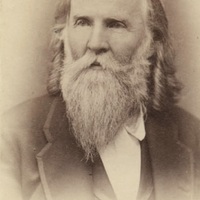
George Shepard Burleigh
- Bibliographic Citation
- George S. Burleigh Papers, 1825-1902. John Hay Library, Brown University. Small Scrapbook 9
- Massachusetts Spy, precise date and reference tbd
- Date
- Date tbd
- Subject
- Oppression
- Political Power
- Abolition
- note
- This poem is problematic for inclusion in George S. Burleigh's corpus for a number of reasons. The pseudonym used here - "K.Q" - is unique to Rycenga's knowledge (as of 14 April 2026). The author of the opening contextual piece - W.B.E. (likely a member of the Earle family, given the location) - indicates he interpolated some lines. However, George Burleigh included the poem in his Small Scrapbook, which contains no writings from other poets.
-
The introduction by W.B.E.: "Mr. Editor—Will you please publish the following lines, which have very opportunely fallen into my possession, for the especial benefit of all those my would support the divine right of Kings, by quotations from the thirteenth chapter of Romans.
Should you happen to think they contain too much of the argumentum ad hominem, I wish to say, with reference to a former occasion, as well as to the present, that in my opinion, the argumentum ad hominem is the best possible argument with which to answer ad captandum logic. How could the collegian, who proved logically that the two chickens on the table were three, have been better answered, than he was, by his father's taking one chicken, his mother's taking the other, and leaving the third one for his share? And, when a man advances what he considers a knock down argument, what can be better than to shew, that his advancing such an argument, is like biting his own nose off, or that his musket,
Although well aimed at duck or plover,
Bore wide and kicked its owner over.
I wish through you, to offer my acknowledgements of the author of the lines, for his kindness in placing them at my disposal, and to ask his pardon for the liberty I have taken, in inserting a stanza, and in making a few verbal alterations, in which, perhaps, ! have sacrificed somewhat of poesy for the sake of strength.
Respectfully, W. B. E." - footnote to the word "recusant," presumably by W.B.E., sets this poem and discussion in a debate within the pages of the newspaper: Fn to “recusant”: “Recusant, from recuso, to deny. In the time of the Romish persecutions in England, a favorite punishment, for those who denied that his Infallible Holiness of Rome was “ordained of God" to lord it over God's heritage, was boring the longue with a red hot iron; this punishment was also used to enforce the Blue Laws of Connecticut. This blue law system is another beautiful practical illustration of the “celestialical government" for which your correspondent C. W. A. contends.”