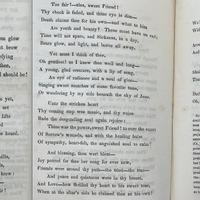

Almira
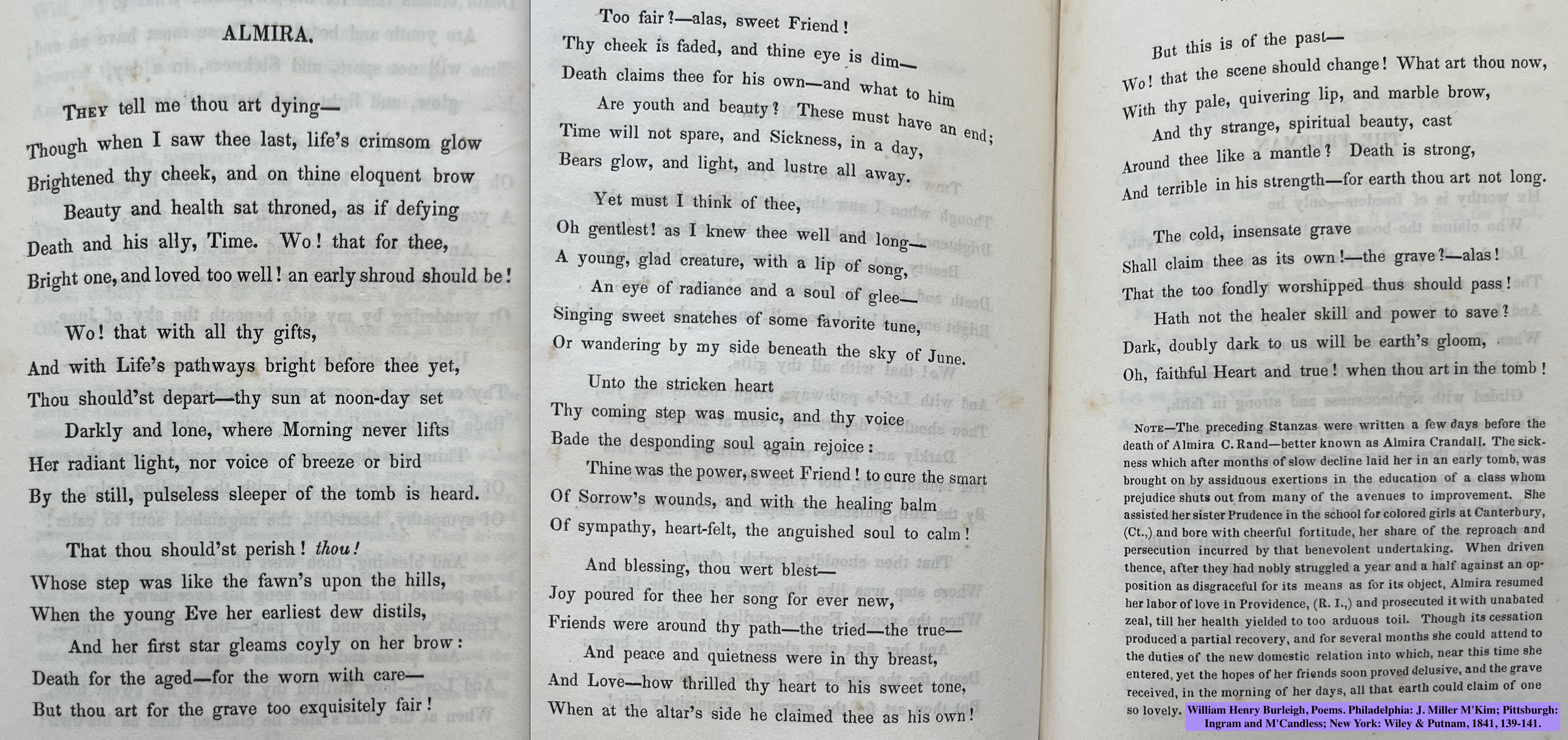
They tell me thou art dying—
Though when I saw thee last, life’s crimson glow
Brightened thy cheek, and on thine eloquent brow
Beauty and health sat throned, as if defying
Death and his ally, Time. Wo! that for thee,
Bright one, and loved too well! an early shroud should be!
Wo! that with all thy gifts,
And with Life’s pathways bright before thou yet,
Thou shoulds’t depart—thy sun at noon-day set
Darkly and lone, where Morning never lifts
Her radiant light, nor voice of breeze or bird
By the still, pathless sleeper of the tomb is heard.
That thou should’st perish! thou!
Whose step was like the fawn’s upon the hills,
When the young Eve her earliest dew distils,
And her first star gleams coyly on her brow:
Death for the aged—for the worn with care—
But thou art for the grave too exquisitely fair!
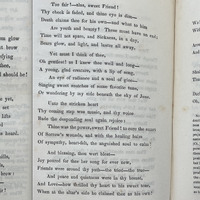
Too fair!—alas, sweet Friend!
Thy cheek is faded, and thine eye is dim—
Death claims thee for his own—and what to him
Are youth and beauty? These must have an end;
Time will not spare, and Sickness, in a day,
Bears glow, and light, and lustre all away.
Yet must I think of thee,
Oh gentlest! as I knew thee well and long—
A young, glad creature, with a lip of song,
An eye of radiance and a soul of glee—
Singing sweet snatches of some favorite tune,
Or wandering by my side beneath the sky of June.
Unto the stricken heart
Thy coming step was music, and thy voice
Bade the desponding soul again rejoice:
Thine was the power, sweet Friend! to cure the smart
Of Sorrow’s wounds, and with the healing balm
Of sympathy, heart-felt, the anguished soul to calm!
And blessing, thou wert blest—
Joy poured for thee her song for ever new,
Friends were around thy path—the tried—the true—
And peace and quietness were in thy breast,
And Love—how thrilled thy heart to his sweet tone,
When at the altar’s side he claimed thee as his own!
But this is of the past—
Wo! that the scene should change! What art thou now,
With thy pale, quivering lip, and marble brow,
And thy strange, spiritual beauty, cast
Around thee like a mantle? Death is strong,
And terrible in his strength—for earth thou are not long.
The cold, insensate grave
Shall claim thee as its own!—the grave?—alas!
That the too fondly worshipped thus should pass!
Hath not the healer skill and power to save?
Dark, doubly dark to us be earth’s gloom.
Oh, faithful Heart and true! when thou art in the tomb!
- Title
- Almira
- First Line
- They tell me thou art dying
- Creator
-
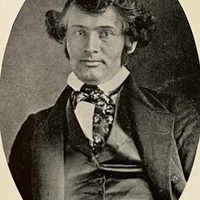 William Henry Burleigh
- Bibliographic Citation
- Burleigh, William Henry, Poems. Philadelphia: J. Miller M'Kim; Pittsburgh: Ingram and M'Candless; New York: Wiley & Putnam, 1841, 139-141.
- Date
- 1837
- Period
- Early
- Subject
- Death
- Youth
- Strong Women Characters
- Destruction of the Canterbury Female Academy
-
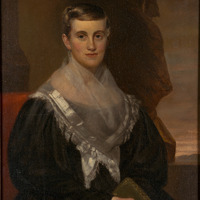
 Almira Crandall
-
 Prudence Crandall
- Comments
- Transcription of note about Almira Crandall Rand: included in the 1841 edition. "The preceding Stanzas were written a few days before the death of Almira C. Rand—better known as Almira Crandall. The sickness which after months of slow decline laid her in an early tomb, was brought on by assiduous exertions in the education of a class whom prejudice shuts out from many of the avenues to improvement. She assisted her sister Prudence in the school for colored girls at Canterbury, (Ct.) and here with cheerful fortitude, her share of the reproach and persecution incurred by that benevolent undertaking. When driven thence, after they had nobly struggle a year and a half against an opposition as disgraceful for its means as for its object. Almira resumed her labor of love in Providence, (R.I.,) and prosecuted it with unabated zeal, till her health yielded to too arduous toil. Though its cessation produced a partial recovery, and for several months she could attend to the duties of the new domestic relation into which, near this time she entered, yet the hopes of her friends soon proved delusive, and the grave received, in the morning of her days, all that earth could claim of one so lovely."
- Not a perfect poem, but an important one for history and for a record of William Burleigh's admiration for Almira Crandall.
- Related Resource
- The Canterbury Female Academy and the Burleighs
- Rating
- ★★★★
- Rights
- Public Domain
- Rights Holder
- Public Domain; photos from copy of book in possession of Jennifer Rycenga
![A. C. R. [Almira Crandall Rand]](https://exhibits.sjsu.edu/application/asset/thumbnails/default.png)